Tactile Orientation and Mobility Strategies for DeafBlind Travelers
A research-informed look at touch-based strategies for DeafBlind Orientation and Mobility instruction. Dr. Amy Parker (Portland State University) and Dr. Tara Brown-Ogilvie (HKNC) share key findings from their collaborative study, followed by a panel of DeafBlind voices and an O&M specialist discussing how the research connects to lived experience: what helps, what gets in the way, and what practitioners can do differently to support accessible, effective travel instruction.
Audience: Orientation and mobility specialists at all experience levels.
This resource includes an archived webinar recording that was originally presented live. It is now available as a stand-alone resource for individuals who were unable to attend the original session or would like to revisit the content.
Downloadable PowerPoint (PDF or Accessible Word Document):
Christine Telford: My name is Christine Telford, and I am the moderator for Tactile O&M Strategies for DeafBlind Travelers. I’m really excited that everyone is here. I’m going to quickly go over some communication access, like etiquette for everybody. It is a webinar, not a Zoom call, so it’s a little bit different for some people.
We’ve designed this webinar to be fully accessible for a range of participants. The webinar includes ASL and spoken English interpretation, live captioning throughout the webinar. We also have a cart link in the chat box that you have access to. Audio descriptions to support participants who are blind, have low vision, or are DeafBlind. And a recording of this webinar will be archived in the HKNC Learning Center with a complete transcript for the future for anyone to review.
If you experience any communication access or technology issues during the webinar, please let us know in the Zoom chat feature or by emailing pld@helenkeller.org. Again, the email is pld@helenkeller.org. Our team will be able to assist you that way also. As I stated before, this is a Zoom webinar. Unlike Zoom meetings, attendees cannot pin individual videos. Throughout the webinar, we will keep both the presenter and the interpreter spotlit on the screen.
If you would like one video to appear larger than the other, you can adjust the size of each screen by dragging the divider between the two videos to the left or the right to customize the layout that best works for you. Communication during the webinar, we ask if you need to ask a question or make a comment. Please use the QA panel in the Zoom webinar.
You can access the QA button from the Zoom webinar toolbar, typically located at the bottom of your window. If you’re using a screen reader, navigate to the QA button in the Zoom toolbar and activate it to open the panel. Your question will be read out loud during one of the designated Q&A sessions so the presenters can respond.
If you have difficulty accessing the Q&A panel or experiencing a communication access or technology issue, again, please use the chat feature or email us at pld@helenkeller.org. Following the webinar, you’ll receive a short evaluation survey. We truly appreciate your feedback and as it helps us to continue improving our trainings and accessibility. As I stated before, my name’s Christine Telford, and I’m the moderator for this session. But our actual presenters are Dr. Amy Parker. Dr. Amy Parker is an associate professor of special education at Portland State University. She has worked with people who are DeafBlind and their families as an advocate, in-home family consultant, technical assistance specialist, and orientation and mobility specialist.
She has designed inclusive multimedia curricula with interdisciplinary teams, including people who are DeafBlind and their families. She is a PI on personal development grants to prepare future O&M specialists, and she leads transportation research grants investigating improved transit design. Her research interests include participatory research, focusing on building more inclusive curricula, communities, and policies.
And our co-presenter is Dr. Tara Brown Ogilvie. She’s a certified orientation mobility specialist with over 15 years of experience working with youth and adults who are DeafBlind in a variety of roles. She is currently the research and accessibility specialist at Helen Keller National Center for DeafBlind Youths and Adults.
Her role is to support a robust research program, collaborate with universities, and provide consultation on inclusive research practices. I’m going to go off-screen now, and I’m going to spotlight Dr. Amy Parker and Dr. Tara Brown Ogilvie. I hope everyone enjoys this webinar.
Dr. Amy Parker: Okay, fantastic.
Dr. Tara Brown-Ogilvie: Real quick, we’re getting a lot of questions about beginning and end codes, soon for CEUs. We are not going to have any beginning or end codes, so don’t worry about that. I believe we’re going to email out something after the webinar. So, thank you.
Dr. Amy Parker: Okay, wonderful. I know those codes are very important, so I’m glad that we are getting that taken care of. Everyone will have one. All right. Just for some visual description, I am Amy Parker. I’m a middle-aged white woman. I’m wearing glasses. I have blonde hair that is according to my age, so it does come from a bottle and from some natural graying that’s going on. But I wanted to welcome you and let you know we’re so honored to be working together. This would be Portland State University and the Helen Keller National Center. We co-designed this research together, and it’s a qualitative study that we’re going to be sharing with you. The purpose of qualitative research is to amplify the voices of participants who aren’t often represented in research.
So, we’re honored today to reflect those voices and really listen to our participants who joined us for the study from across the country. I’m going to go to the next slide, and I’m going to put this in slideshow. So hopefully this helps you see the slides a little bit better as we go forward. So today we’re going to be talking about this qualitative research that we engaged in, and this included some Master’s research students at Portland State University. It included Dr. Megan Conway from the Helen Keller National Center, and Dr. Tara Brown Ogilvie, who’s joining us today as one of the presenters. We’re going to talk about the benefits of touch, and we’re so honored today to have Deb Marinos, who is a DeafBlind leader from Oregon, who has a master’s degree. She’ll be introduced and share some of her expertise. We have Maricar Marquez, and I have not congratulated Maricar on earning her second master’s degree, who is a DeafBlind leader and a director of independent living services at the Helen Keller National Center. And another dear colleague and friend, Hex, Heather Lightfoot, who is a certified orientation and mobility specialist who happens to be Deaf and is also the mother of a DeafBlind child.
We’re going to be deliberate in asking these panelists to join us today because they mirror our study. They mirror examples of people who we talk to in the community. Some DeafBlind adults who use speech or are hard of hearing, and some DeafBlind adults who use tactile sign language, DeafBlind adults who use close-range visual sign language, and of course, orientation and mobility specialists.
It was wonderful to have orientation and mobility specialists who were hearing/sighted, but we also had orientation and mobility specialists who were Deaf and hard of hearing themselves. So, we know that orientation and mobility traditionally grew out of World War II, and it grew out of services for people who were returning from the war. And the traditional curriculum in orientation and mobility relies heavily on audition and spoken language. There’s been limited emphasis on orientation and mobility that includes strategies for people who are DeafBlind. We’ll talk about some of the leaders who come before us and their contributions to the limited body of research that does exist, but we know that there hasn’t really been enough emphasis on touch-based curriculum and other strategies that are used for orientation and mobility, which is part of why we conducted this study.
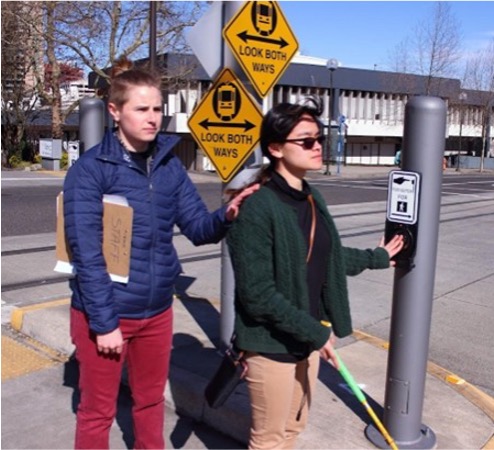
We also know that there’s minimal preparation in DeafBlind travel strategies, and this image right here is an image that’s dear to me. It is of a colleague who is DeafBlind. She has Usher syndrome type 1, and she’s standing with her hand touching an accessible pedestrian signal that’s offering vibratory feedback. She has her cane in front of her positioned to make a street crossing. She’s using her central vision to look across the roadway at the pedestrian signal, and she’s also combining that with the vibratory feedback that’s going to come from the APS. The orientation and mobility specialist at this time, they were an intern, and I was watching them. This was part of a practicum experience that this professional is having. Their name is Kai, and they work in the Portland, Oregon area. They also started out as an interpreter. And now are a certified orientation and mobility specialist and a teacher of students who are blind or low vision. But Kai has their hand on the traveler’s shoulder, and that’s again for showing respect and support to the traveler and also letting the traveler know where they are positioned.
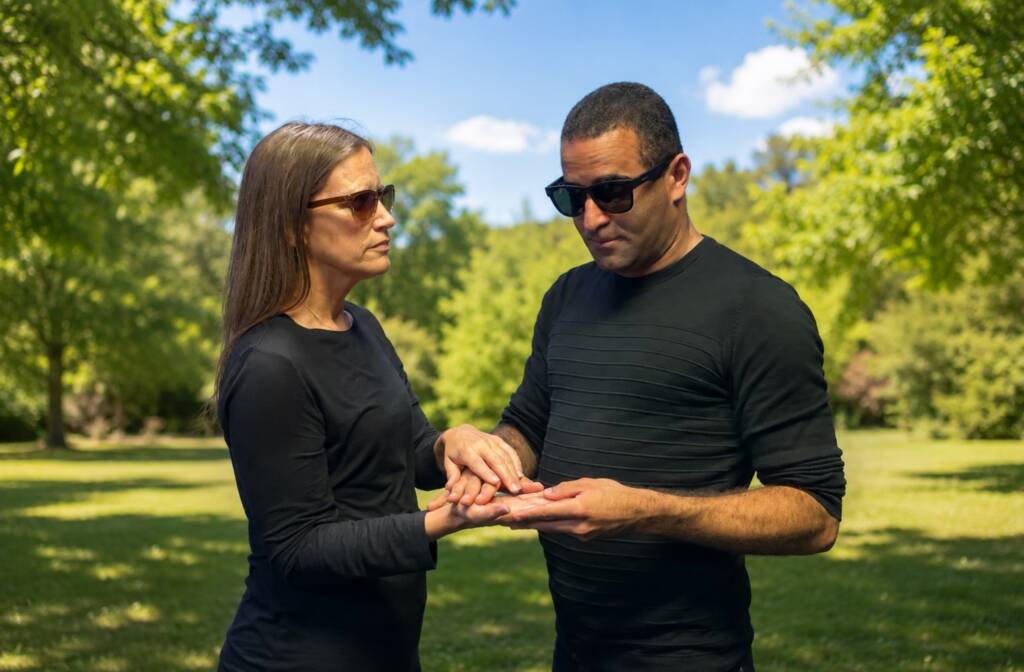
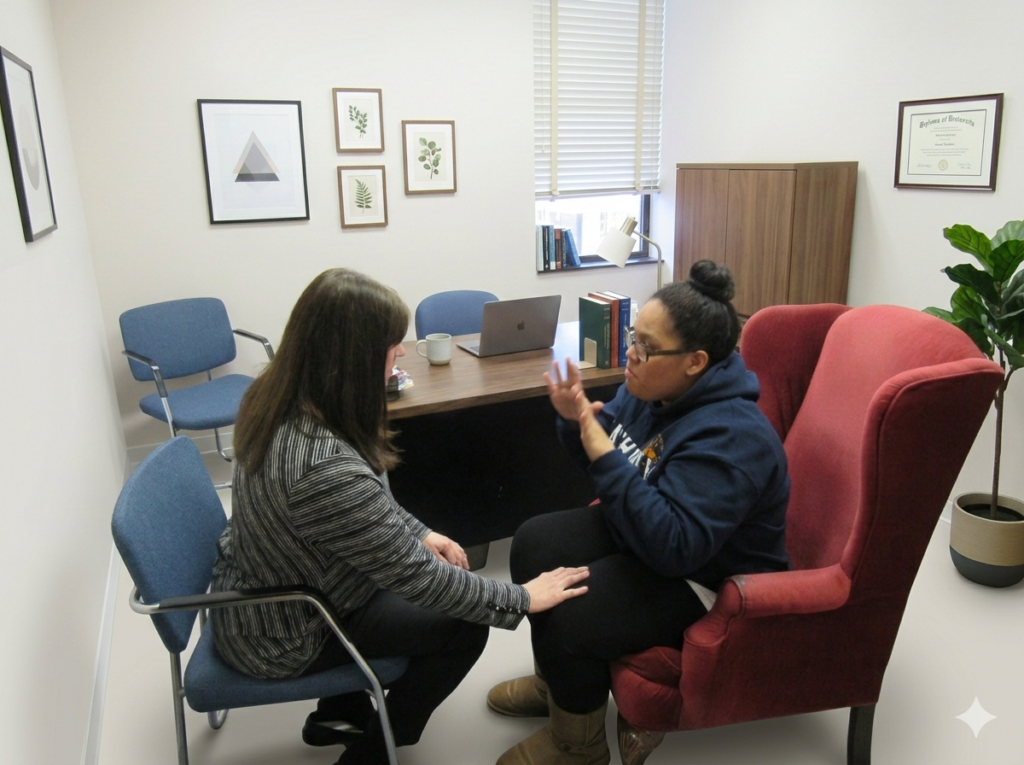
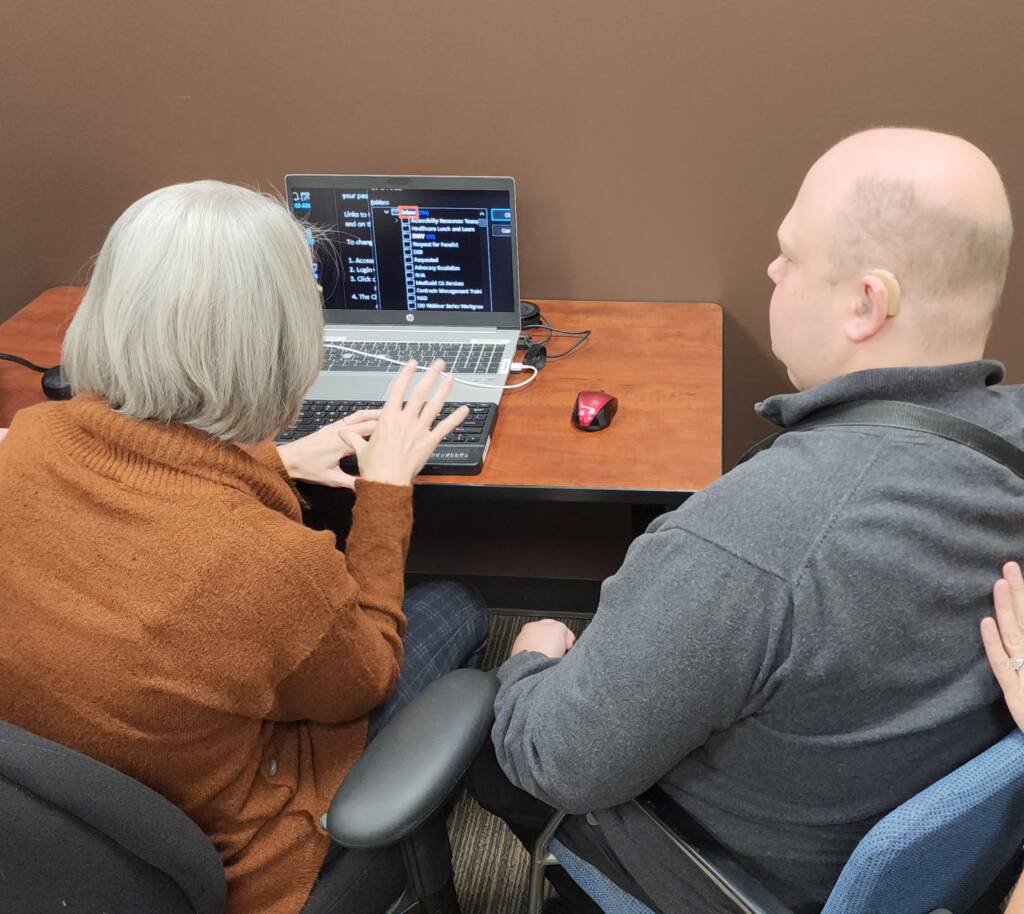
I do also want to go back just very briefly and say that on this first slide, the woman who is pictured here is someone who many people know who’s a DeafBlind leader. Her name is Yalitza Nuccio, and she runs a Protactile house in Oregon, has worked for many years in Seattle, Washington, and is a leader in the DeafBlind community. And in this picture, she is engaged in a presentation to my students at Portland State University, and there is a woman who has gray hair and has a long braid. Both the women in the picture, actually all three, are Caucasian, and Yalitza is communicating and leading the workshop and using tactile sign language.
As I mentioned, going ahead, this was a qualitative research study in which we had 12 diverse DeafBlind adults from across the country. We had 20 orientation and mobility specialists, and we engaged in demographic questionnaires. We asked people about their confidence in travel. We asked them about their background and experience in orientation and mobility. For the O&M specialist, we asked, “How long have you been teaching?” And we offered focus group conversations, which in and of itself to do focus group conversations when people use tactile American Sign Language, we had to think out of the box about how to provide interpreting support in people’s local communities.
But this was also a part of a team effort, and we could not have done this without the partnership with Helen Keller National Center and with the Portland State University graduate students. They provided financial support for the interpreters to be provided both on screen but also in person. Then we, as a team, engaged in some peer-reviewed thematic coding. We had 12 DeafBlind adults aged 20 to 76. We had people represented of different races and ethnicities. We had Pacific Islanders, one Pacific Islander. We had eight Caucasians. We had two people of Asian descent and two people who were African American. In primary language, most of the participants in the study who were DeafBlind used spoken English, but four used American Sign Language, and one individual whose first language was Bengali. I don’t know, Tara. There’s some questions coming through or people who have their hands raised. I’m going to try to get through this, and we are going to be able to take questions at the end. So if you can hold your questions, we do want to acknowledge you and respond to you. Or if you can put your questions in, into the Q&A, that will help us keep track of them and respond to you.
So, for our 20 O&M specialists who participated, again, we had diverse representation, which was wonderful. 18 of the O&M specialists who participated use spoken English as their primary language, and two used American Sign Language. There were also some folks, orientation and mobility specialists, who had different roles. Some had played the role of a support service provider or co-navigator, some had been an interpreter or were still an interpreter, and some were a parent of a DeafBlind person.
Christine Telford: Dr. Parker? We’re gonna switch interpreters really quickly. Okay, you’re ready to go.
Dr. Amy Parker: So now we’re on the slide that’s describing the benefits of tactile O&M strategies.
What we wanted to know when we talked to people, and again, one of the reasons why you do qualitative research is you want to describe people’s experiences. If we had started out with just a survey or if we had started out with some other type of research, we probably wouldn’t have gotten as much information as we needed. We wanted to talk to people about their lived experiences. We wanted to learn from DeafBlind people from their own perspective, as well as from O&M specialists, what do they do when they’re learning orientation and mobility? What’s effective for learning? What’s effective for teaching? And here are some of the benefits that they told us.
They said when providing physical touch, it’s important to do this because it can provide reassurance and confirmation. We’ll actually talk about how touch provides confirmation of what people use from their other senses. We know that many DeafBlind people use residual hearing. Many DeafBlind people use residual vision.
And then of course, they use other sensory information. What we learned from people was that touch, whether it be haptics or protactile strategies or other types of touch that is incidental when people are teaching and learning and communicating, that is very important for confirming what someone is picking up or accessing from their other senses.
So, it’s a confirmatory sense, as well as a reassurance. In the image that we showed of the traveler with Usher syndrome type one who was making a street crossing, it was reassuring to them to know where their instructor was, also without being interrupted. Also, reassurance of where the position of their instructor was, so that wasn’t left to chance. That was a part of the entire teaching process. DeafBlind travelers and O&M specialists talked about the time that it takes for tactile exploration, that the fingers and the hands and the body can pick up and put together information. It may take a little more time than what we pick up from our visual sense, and that having the time for tactile exploration is very important for making meaning of those landmarks in the environment.
Tactile maps and models were also mentioned in our research process that were very important for getting a snapshot or an overview of a particular space, and then also for understanding the relationships between landmarks in space. And having options, having agency or self-determination for refining navigation skills and knowing there’s more than one way to get there. So again, using the tactile sense, but having tactile maps and models. And people mentioned some that were professional tactile maps and models, and some were homemade. And some of the O&M specialists actually sent us photographs of those tactile maps and models that they had designed and used. And other DeafBlind people said when their O&M specialist took the time to teach them how to read a map, that it was very meaningful to their understanding of space and to their understanding of the environment and to their agency in the environment.
And then folks also mentioned haptic technology, the importance of haptic technology where there’s vibratory feedback that can be helpful for very specific tasks. So now I want to turn it over to our DeafBlind panelists who we could not do this work without the community. And in honor of Helen Keller National Center’s work, in honor of Helen Keller’s birthday and DeafBlind Awareness Week, we want to turn it over to our panelists
Dr. Tara Brown-Ogilvie: This is Dr. Tara Brown Ogilvie. I’m going to be introducing our panelists. If you could go to the next slide, please. Okay. The first panelist is going to be Deb Marinos. She was the founder of Adaptability for Life, LLC, licensed professional counselor, LPC, certified rehabilitation counselor, counselor CRC, and has an MS in counseling. So, Deb is going to talk a little bit about her experiences as a person who identifies as being blind and hard of hearing. And what we’re going to do is actually just give all the bios at once, and then we will go one at a time with the different panelists. So, we’re going to go ahead and just introduce Maricar Marquez. She’s going to be providing a lived experience as someone who uses tactile ASL and identifies as being culturally DeafBlind. She is the supervisor at HKNC of the independent living department. She, as Amy mentioned, getting her second master’s in vision rehab therapy, UMass Boston. And she also has an MS in administration from Gallaudet University, and a BA in Communication Arts from Gallaudet as well. Next slide.
This is for our O&M specialists. So we’re having two DeafBlind travelers who are going to talk about their experiences from being the ones that are going through the lessons, and how touch is important in that regard. And then we’re also going to have a flipped perspective with Heather, or Hex, Lightfoot. She is a Deaf O&M specialist who also has a son who is DeafBlind, and so she has a lot of experience with using touch, and she’s going to talk a little bit about her experience as a CODA, Deaf mother of three, having a DeafBlind teenager.
She also has her Master’s of Education in Special Ed and a DeafBlind graduate certificate from Texas Tech University, and also an alumna of Gallaudet University and Texas Tech. I first met Hex at a DeafBlind conference in Texas. She’s great to work with. We’re going to go ahead and get started with Deb. Deb, if you could just turn on your camera, please. We’ll go ahead and switch places. Great. Go right ahead, Deb. Let us know if you need anything. We can take down the slide, please.
Deb Marinos: So, I am Deb Marinos, and I am 68 years old. And just as a little bit of background, I was born moderately severe hearing loss, but I wasn’t diagnosed with the vision loss until age 35, and I was an electrician at the time. And it wasn’t cool or even possible to keep my job and use a long white cane, but I worked in a lot of uneven ground and holes in the job- and so, it was really interesting. I used a lot of different tactile methods at those times, and audio. I used an FM system. I used many different ways to get around the job sites safely until I was able to move to a different career where it’s okay to have a white cane. So, I’ve used guide dogs, and I do have residual hearing, and I use hearing aids quite well.
Unfortunately, it is also decreasing, so I now have a cochlear implant, which is actually starting to work pretty well. I also used a lot of assistive listening devices, environmental cues, and smell. I’m really good at feeling the wind on my face, so I can tell when a building line, all the things that we get to teach in. So, I do have what’s called Usher syndrome type 2A. I definitely have some useful vision for reading texts and print, but not necessarily useful vision for mobility. In fact, it’s, it lies to me more than it tells me anything good. Likewise, like many people with hard-of-hearing, the, how well that works varies dramatically depending on the brain fatigue, the background noise, and hearing aid programming. So, it’s not cool if somebody says stop and a truck just went by, because I’m not going to hear it or not know what it is. And so my focus is on how touch can support safe and effective mobility instruction. And as Amy said, it is reassuring to know that somebody’s gonna grab your shoulder and say stop at the same time, because then you don’t have to sit there stressing out about what you might not hear or it might be unreliable.
Is that go or no sometimes can be very difficult. So, one of the things that I used and was later able to teach my mobility instructors, when we pulled wire as an electrician, we were often several hundred feet away. We had to know when to pull and when to stop, so we always used two slow stops, bap, bap on the pipe for go, and we used three, four, five, bap, bap, bap, bap meant stop.
And so that’s just a simple way that touch can be used and it, you know, whatever system you end up working out, it doesn’t have to be official, but it is better if everybody’s using the same tools if you have bunches of people you’re working with. I also appreciate people standing on my good side. I always have one better ear than the other, and I appreciate shoulder touch. If you want me to move over to the right, you can touch my shoulder right or I could slide right. So, the why we talked a little bit about, but remember that if I’m stressed out by thinking that I might miss a critical safety message, I may walk slower. I may be less focused, and I may be more reluctant to go out and tackle a particularly complicated intersection. So, prevent confusion, reduce energy and cognitive effort is super important because I don’t get as tired as quickly. Another example where we need to be really conscious of the difference or the fact that I’m hard of hearing, First Street or Fir Street may sound exactly the same to me, and there’s a couple of ways…
If you have the traveler on the wrong route, then all kinds of things can happen because you haven’t previewed that route. Some strategies might be map building, as we talked about, but most important thing is to have the traveler repeat the instructions back because then you’ll notice that they haven’t got it right, and you can spell out the last S and T or alphanumerically P for Papa, whatever you have to do to make it clear. Do remember the better ear, get closer, not louder.
Louder only accentuates the vowels. It doesn’t do anything for the consonants. So in the case of fur, you can yell fur and first all day long, it’s not gonna make that S and T any louder. Fingerspelling, I do know enough ASL. I was fortunate enough to go to Helen Keller, and I learned a little bit. Use whatever somebody can put up with or they can learn in a minute. Drawing, I appreciate draw on my back. I’m particularly fond of that. Here’s the four corners and here’s what’s here and here’s the fire hydrant or whatever. I’m particularly fond of those kinds. And I do love the Wheatley boards, but I also, Leader Dogs had a map with different textured straws or sticks, and it was really fun because the busier streets were bigger, and that was just really memorable to me.
I really enjoyed that. If I didn’t remember the names, it didn’t matter. I knew it was the big street, the little street, and I knew how it was gonna work as far as traveling. Some important things to consider in optimizing both remaining vision and hearing, and when both may fail. So working with residual hearing, you have to have effective teaching on how to evaluate the quality of the available information and when an alternate route may be safer choice.
I had several guide dogs, and at one intersection, I just don’t like the sound of it. The street doesn’t sound straight. Normally, I’m really good. I can tell you where the traffic is and what it is, but for whatever reason, I got that one wrong. So we have to take some time at the corner and go, “Yeah, this car’s going here, that car’s going there. Nope, that’s not true. Uh-oh.” And then conversely, there’s some street that have manhole covers that are really handy because you can use that for a clue, too. So it’s okay to take a different route. As Amy said, we have to have backup plan, communication cards, sighted assistant,texts. In my neighborhood, if I get stuck out and I don’t like the traffic pattern or the sunlight is too bright and I can’t see to cross, I have a list of people in my phone that I can call that will run out and help me get across that last intersection before I get to my apartment. One of the stories I wanted to tell you about is the use of remote microphones. My sister and I both have the same thing, and we went traveling and we were in an airport. We each had each other’s remote microphone, and we’re talking away, but we finally got out of range and realized that we had walked away from each other. She had a guide dog, I had a cane at that point. That was kind of comical but stressful finding each other again because you lose all environmental sound.
You think that person’s right there talking to you in your ear, but actually they just wandered off 100 feet. I don’t recommend using those when you’re actually doing mobility. They’re great for communicating ahead of time, but because they change the programming in the hearing aid and they take away the environmental sound and they change it. They literally change it because they’ll spin the microphone around to match the speech, and so that can be quite, I remember walking out with the first hearing aid with my last dog out of the hearing aid office, and I told the dog forward, and he said, “No, we’re not having any.” And it turned out that the microphone turned away from the noise, and there was two cars coming, and the dog was like, “What? You’ve lost your mind.” Thankfully, but now I’m much more careful when I get a new hearing aid to tell the audiologist that, “Hey, you know, we gotta look at these settings and make sure that we’re not getting rid of the noise I need to hear.” I also have a program for sitting in a dining room where it’s noisy so I can hear speech.
So you have multiple channels. You also have to remember that things like construction, buses, other loud vehicles, and weather, the wind blowing, can sometimes really affect a hearing aid’s performance. And then one of the last things I want to talk about is the GPS and route guidance stuff. It’s great to know where you’re going. It is not great if you have it plumbed into your hearing aid. Same thing as the remote microphone. It’s an absolute safety hazard to have the thing chattering away at the intersection when you’re trying to hear the traffic. So, my way of fixing that is I have this little remote, it’s a Bluetooth construction speaker left over from my own work. It happens to have a tactile button, and it happens to talk when you turn it on and off. And so, I connect that to my phone and GPS, disconnect it from my hearing aid directly, and it sits on my shoulder on my strap. And if I want it to shut up, I can make it shut up very quickly. I can just reach over and bop it.
That way I can still have my GPS but not have it taking over my hearing aid and blocking my safety. So for many people, they talked about the extra time needed. It’s just so important to have the time to be able to do it safely because if we have those unsafe moments, it really gonna change whether a person feels like they can be independent travelers.
I would have been very sad if I hadn’t learned all this stuff at the beginning, because I love taking off and going wherever I feel like going whenever I want to, and I stay safe
Dr. Tara Brown-Ogilvie: This is Tara real quick. Deb,, I just want to thank you for all the great strategies and things that you’ve mentioned. I think we’re going to have a quick interpreter switch. Just hold on for one moment okay, great. Anything else you want to add, Deb, before we wrap up with your panel?
Deb Marinos: My closing statement: touch is often the tool that helps organize information, reduce ambiguity, and support confident travel decisions.
Dr. Tara Brown-Ogilvie: Awesome. I really appreciate it, and I just really want to reiterate some of the great things you said. How you benefited when someone would draw on your back, and how you could use haptics to tell the difference between things like First and Third Street. Also, how you could solicit assistance, and it’s okay to take an alternative route. Really, it is perfectly fine to do such a thing, and I always recommend it, too. And then as well as having spatial awareness of either your sister or your O&M instructor, having some type of touch point contact so you know where each other are in space. And allowing more time is so important, because you need more time to be able to explore tactically, to set up these things, and to create a system that works for both you and the instructor, because you both have to be on the same page for it to work. Thank you so much, Deb. I really appreciate your wonderful insights. I’m going to go ahead and get ready for our next speaker, who’s going to be Maricar. Just one moment. Okay, we’re all set. Go ahead, Maricar.
Maricar Marquez: Hello, everyone. Thank you so much, Tara. I am Maricar Marquez. I’m using American Sign Language, and I have a voice interpreter here with me. I’m very excited to be with you here this afternoon to discuss this important topic of strategies to use for mobility.
I’m an Asian woman with black hair with a black sweater on. I was a visual traveler, and then I transitioned over to using touch, and wow, there was definitely some challenges and a learning curve with different skills and techniques I had to learn. As for transporting to work or going to the salon or going to get my hair done or going out into the public, I need to be able to use a taxi. Or I use things such as paratransit, going to the airport, going on the subway. There were many challenges in all these areas that I had to learn, and really the critical point for me was touch. Incorporating touch with the use of haptics with tactile sign language as well as PT for me. I also use braille.
I use tactile markers and objects. And all of these features incorporated together are things that I rely on for the flow and process of instruction. To be able to learn as a traveler. It’s not just one strategy, it’s all of them and how they work together while learning. Two critical benefits for touch strategies are communication access and for providing visual and environmental information in real time. In terms of communication access, when I grew up as a Deaf visual ASL signer, I used visual ASL to express myself. As time went on and I lost more vision, I used tactile sign language to receive information. Having a teacher who can communicate with me directly with tactile sign language, and again, tactile sign language is ASL with some modifications with it.
Having that sense of touch is important. When talking with the hearing public that does not know any sign language and I’m out there, you bump into people. You might be wondering how I communicate with them, and that way I might use braille. I’ll also then use my iPhone, which connects to my braille display. I can place a phone call using IP relay. I can reserve a cab for myself. I can make a reservation for paratransit, make a plan to where I need to go. And, if I’m unfamiliar with the area that I’m going to, I can also get assistance from a care assistant if I need somebody to travel with me to an unfamiliar environment. I’ll even use communication cards with braille on them where I can then hold them up to interact with a hearing person, and they would be able to respond to me. You might be wondering how they respond. It might say, “Please text me. Please use your iPhone to text me a message,” which then I would read on my braille display, and we can have a conversation back and forth via text. That is effective communication with the general hearing public.
Another benefit is providing visual environmental information in real time. Haptics is a standardized system of symbols to provide visual and environmental information. That includes directions, it has directional symbols, it has various levels you can utilize. And I’m going to give you an explanation as to where you’re going to go. There are a host of many other symbols out there as a part of this system, and they can all give you information in real time. So for example, let’s say I’m walking with a white cane or with a guide dog, and I’m with my instructor who is behind me. And let’s say I stop. I’m stuck. I’m trying to figure out where to go. The person, my instructor behind me, can use a directional signal on my back to let me know the information about which way to go. They can direct me to the right, to the left, this to go forward or straight. They don’t need to engage with me in tactile sign language. They can give me the information on my back in real time.
Also, in terms of levels, which I’m demonstrating here on my arm, that could be used to give me information about stairs. Are the stairs going up? Are the stairs going down? What’s the degree? How deep the stairs are, so on and so forth.
Let’s say I have my guide dog with me and I’m out for a walk, and I feel the dog is very distracted. His body language, I can see something’s going on with him. He’s distracted by perhaps another dog in the distance. Someone could let me know, again, with haptics, that there is another dog in the distance that my dog is being distracted by. So there are many benefits to haptics to get a visual environmental information in real time so that you know what’s happening in the area. As for mapping, you’re mapping out an area and using touch with different markers and objects. In the Wheatley board, when you set up the layout there, it represents the different items, the different landmarks you’ll encounter. So let’s say you’re going into a vast environment. Let’s say Grand Central Station in New York City, and there’s all different entrances to get to the various trains. It is extremely crowded there, and it’s very overwhelming to be in that environment. Using the Wheatley board and having that layout there, talking about it in sign language, utilizing the Wheatley board, and using haptics that you set standardized on your back layout of what it would look like. And then using Print-on-Palm if you need to, you can exchange and have different pieces of information and have various strategies so you can understand what Grand Central looks like
Dr. Tara Brown-Ogilvie: This is Tara real quick. Could you expand on Print-on-Palm, Maricar? I’d love to see if you can give an example and talk about it a little bit. Print-on-Palm, or POP, as I like to call it. Yes. Maricar, could you expand on Print-on-Palm or POP, POP?
Maricar Marquez: This is Maricar. Print-on-Palm, POP, is when you use the surface of your hand with capital letters, where you’d make a capital A in the person’s hand and other letters to be able to communicate. It is a communication tool to be able to talk with the non-signing public.
Dr. Tara Brown-Ogilvie: Awesome. Thank you.
Maricar Marquez: Okay. So going back to mapping. The practicality of mapping when you’re learning using touch and your hands on that surface is very important.
It’s important, again, to go back to this, to allow time. To learn something tactfully, such as using a Wheatley board, you have to figure out what something is. You might not know what it is. You might not necessarily be used to it, and you have to learn each unique area. Compared, learning with touch and receiving information with touch with your instructor, it’s different. Some teachers might be very light in how they provide you tactile, haptic information. You need to have a firm touch. So you need to learn everyone’s different style, what their level of touch is, and what degree they would like it, and prevent misunderstanding because that might happen when you’re working with different providers.
You need to be able to accommodate what level of touch the person wants, and also takes time to learn and receptively be able to receive the information. Other challenges in using touch is it could depend on the day exactly what the person’s wearing. Are they wearing a thick sweater? Is it cold outside? Are they bundled up? Are you trying to give them information on their back as they’re walking in the cold? And you have to make sure you’re giving a very firm touch there because they also might not feel. There might be some miscommunication. So you need to think creatively on which side you’re going to give the information on, what the person’s wearing, and adjust according to the day. And another challenge is.
Dr. Tara Brown-Ogilvie: This is Tara. I’d love to listen to you all day, Maricar. If you want to wrap it up, please, and we’re going to move on to the next contestant. And sorry about the interpreting glitch earlier. I apologize for that, but we did repeat that we were talking about the Print-on-Palm. Go ahead, Maricar, and wrap it up.
Maricar Marquez: Yes. And just one more challenge I do want to share. Every instructor is different. Their styles are different. I have experience working with many instructors and also with utilizing interpreters during those classes. And I must say, I really prefer direct communication. It is much more quick. Issues are going to come up, but it’s important to work with your DeafBlind client and the instructor, that they work together to overcome these barriers that might come, and using touch independently travel and become a confident independent traveler.
Dr. Tara Brown-Ogilvie: Tara’s speaking. When I speak, the interpreter magically appears. Thank you, Maricar. You are just a wealth of knowledge, really, seriously. And Maricar does a lot of haptics trainings and has a lot of great experiences. And we’re gonna talk a little bit later about how part of our research found that we really need DeafBlind-led workshops and trainings and just more insights, perhaps having DeafBlind individuals go to an O&M program or be able to do some practice runs at a seminar or something of that nature. So Maricar, thank you once again for sharing your wisdom with us. Okay. And Hex, H-E-X, Hex is on next One moment while we get everything set up with the spotlight. Ashley, need you for a sec. Okay, so this is Tara. I just wanted to say hello. Hex, you’re all set. Go right ahead and let me know if you need anything.
Hex: Hello. Yes. Okay, great. Sounds good. Thank you, Tara. Hello, everyone. You can call me Hex. I am also a middle-aged white woman with almost white hair and a dark top on. I’m signing in ASL, which is my language of choice. What I’d like to share with all of you is some information, educational accidents we can call them. They’re mistakes. We learn from our mistakes, right? So if there weren’t any mistakes, then we wouldn’t ever learn anything. So these mistakes are things that I’ve learned from. I am a mom of three, as well as a certified O&M specialist. I’m a friend and a family member. I’ve learned from working with colleagues as well.
I mentioned I have three kids. My oldest is Deaf, my middle is the CODA, and then my third is DeafBlind, who will be 16 just next month. My DeafBlind child has no light perception and is profoundly Deaf. Their name is Orion. Sign name is O third. My perspective as a Deaf person, when Orion was born blind and they were doing the screening test. We found they were Deaf, and I mean, I’m a Deaf person, so I knew that audio access, I understood that. We have no hearing access at all, and then adding in no visual access, we’re taking away those two senses. The next sense for access would be touch, right? Typically, that’s what you would depend on, and so that was our family’s focus, was on touch. We use touch all the time at home. It’s not just our lifestyle. Touch is our life. And touch really the tactile sense is very common sense. You know, where to touch, how to touch, it’s pretty common sense. I like to say when in doubt, just touch.
So for my O&M practices, first, if a new person is with me or maybe summer has just finished and I have a student, I’m going to check with the person. I’m going to check with the family. I’m just gonna make sure that we’re clear on what are your experiences with touch? Where are you and how do you feel about touch, and what have you picked up on? Maybe someone has a medical diagnosis that we need to be careful about touch. Maybe they feel pain with touch. Maybe there’s chronic pain. Maybe the person, it’s something they can’t control. And so I really like to make sure that I think about that. Oh, perfect. And it’s good that I took a break. I’m trying to go easy on the interpreters. Love you, interpreters.
I want to use the student’s preferred mode of communication. I work with a very diverse population of students that are DeafBlind, low vision, hearing blind, with or without additional disabilities intermingled in there as well. Some use ASL, that are DeafBlind, some of them do use ASL. I have used interpreters with DeafBlind students that are more oral-focused, that speak a spoken language.
It’s pretty cool to see the student start to pick up some signs and throw those in there. Many of us are still on a journey. So it’s interesting to watch them, and I look forward to their futures. Something that I consider for O&M practice, but also with my son, Orion, at home, is I want to be careful to not startle anyone. I always want to make sure that they are aware of my presence and my approach. Indirect touch would be, for example, if someone is leaning on a table, I could touch the table first. So they’re touching the table, I can touch the table, then touch them. Maybe there’s a stroller, they’re in a stroller, or their bed, or any surface that they’re on. I can touch that surface near them first and then the person. Then a workaround to not startle someone is just to maintain contact because then you’re always there. The discussion of touch and boundaries.
Oh, Tara popped up. What does that mean?
Dr. Tara Brown-Ogilvie: We’re just going to do interpreter switch, please. But you’re on it. Thank you.
Hex: Okay. We have the interpreter ready to go. We just need to spotlight the interpreter. Talking about boundaries, right? A lot of students, their experience on campus, they experience touch just fine, but when they’re off campus, touch is almost off-limits, and so that’s a really important discussion to have with them. Additionally, having those types of prior conversations, what does touch indicate? What does it mean? It might mean stop or instead of going ahead with a particular activity, with a new touch, so to speak, out there, well, what does that mean? So having those discussions ahead of time so that you know how to use touch, when to use it, is always going to be more beneficial.
Modeling for those skills to use for students and showing them yourself using the different tools and techniques with regards to touch, modeling that for students is incredibly important as well, and then be able to do a role reversal where those students can practice on you. They can practice touches that indicate stop or an affirmative yes or keep going.
You can model it and then have them use touch on you. Additionally, giving ample space and time for the students to show you what they can do. Right? It’s really, it’s in parallel, too, with your right hand and how that works, being mindful to go slow with tactile communication and using touch and the sense of touch with communicating, especially with someone who’s new. They’re still learning how to track you, how to track your hand with the various signs or gestures or touches. You want to do it so fast that it ends up like, “Where’d you go?” That kind of idea. It’s important to stay intentional, keep the pace, and go slow, especially in the beginning, so that people can get that sense of being able to track you, building more confidence, and allowing enough time for that to happen organically.
In terms of the benefits of touch, and we’ve already talked about some of them already, but just on the go, you don’t even have to stop. You can just continual… you can just keep going with whatever activity that you’re doing. And if a person turns, you might lose a sense of direction. We’re talking about travel during this webinar. How do you learn that? By mistakes, trial and error. “Hey, I was talking to you,” and you turn around, and then all of a sudden, if a person turns their point of view or how they’re facing you, it’s all of a sudden, where did they go? And say, “Hang on a second,” and just, you turn back around and continue to practice those opportunities to maintain connections and to be able to have those things happen successfully. All right. I think you’re muted.
Dr. Tara Brown-Ogilvie: Okay, Hex, you want to just wrap up a little bit? We’re short on your time.
Hex: Okay. I will go ahead and wrap up, Tara. Thank you. Again, really important key that I just want to impress upon everybody here, if I can leave you with anything, is that touching on the back of a DeafBlind person, it might be something where there’s a… having a systematic approach like a search opportunity where you’re able to use touching on the back and you’re able to indicate that you are looking for something. You’re able to glide your hand from left to right, almost like you’re tracking on the back. A person can feel, okay, we’re going from left to right, and then it stops and indicates a very specific connotation. Additionally, being able to use a GPS that’s on a mobile device, you can also indicate that scrolling technique with the middle finger in a up-down fashion. But it’s so incredibly important just to be willing to do these things, to know that a touch is so incredibly valuable in terms of navigation. The last thing you want to have happen is for someone to be lost, right? So having someone, whether it’s friends, family, a guide, a student, they are gathering information. When you see someone wandering, like the old adage goes, not all who wanders are lost. If you see someone who might look like they’re wandering, might just be gathering invaluable information. Thank you so much for your time, everyone.
Dr. Tara Brown-Ogilvie: Okay, and this is Tara, just to thank you, Hex, so much. It’s so great learning from you and from your perspective. And I just love what you were saying about you don’t want to startle someone, because I’ve done that too where I went to touch someone and they went, “Ah!” So, you have to really be mindful that everyone’s so different when it comes to pressure and touch and things of that nature. And I also do that when there’s a table, especially at a conference center or a business meeting. I will just kind of do something with the table to give a little heads up, and that’s always really nice. Lastly, when I do work with little kids, as you work with a lot of kids, when you say you move because you hear someone speaking, but then you lose your orientation. I always say, “Nose, toes, goes.”
Nose, toes, goes. That means you have to get your nose directed with your toes so that you can continue forward in your orientation and not get carried away. I’m going to go ahead and give it to Amy. Thank you again, Hex. And we will have some Q&A at the end. Maricar, I saw your camera flip on for a second, so we will do at the very end.
Dr. Amy Parker: Thank you. This is Amy speaking. I am smiling. I’m smiling broadly because of the wonderful panelists that have added to our webinar today. Again, as I was saying, we really wanted to amplify the voices of DeafBlind travelers in this study and to hear what they had to say. I think they said it so beautifully. Between the insights from Deb using a construction microphone, but not using it during mobility, using it for communication, and then using other sounds for mobility, turning that off. Between Maricar describing the map on the back in real time, plus the use of haptics, plus the use of real maps to understand Grand Central Station. And the insights of Hex as a mother, as an orientation and mobility specialist working with children as well. Our study did not include children. We only spoke with DeafBlind adults for this particular study. But what Hex was mentioning about working with children rings true, that we’re all on a journey, and that touch takes time to learn.
So, what we did, the study takeaways, we listened to people in the focus groups, the DeafBlind travelers, the O&M specialists, and then we did some comparison of those insights and perspectives. Some of the most exciting things we learned were those incidental pearls, just like Maricar, just like Deb shared with you, like Hex shared with you as an O&M specialist, that these were things that were learned with members of the DeafBlind community, that were learned as they were traveling.
Both Maricar and Deb mentioned that they use guide dog mobility, that they have had guide dogs and they have worked with guide dog teams, and what the dogs were communicating through touch is something that I think is worth its own study. So just to summarize some of our insights from those that we learned from, touch requires consent and collaboration.
As Hex was saying, as others were saying, it requires mutuality so that someone isn’t startled. We know that being startled is not a pleasant experience, and that can disrupt our nervous system and our ability to focus effectively. So we certainly want to come up with a way that is respectful and that both people understand this is what this touch means.
This is how I’m going to use touch to indicate where I’m standing, so that I don’t interrupt you, or to indicate the direction of traffic. That there are cultural preferences around touch, and that has to be negotiated and understood. I love what Hex said about giving someone a warning by using other taps or other haptic information on a table before touching someone’s body or maintaining contact with them.
I think that’s one of the key differences in DeafBlind orientation and mobility that we’re learning, is that touch is needed, is far more needed, and positioning and understanding positioning and how to interpret the environment is a big part of both communication and teaching and learning. So that the misuse of touch, as we know, can cause discomfort or distress, which will interrupt the lessons.
In case of emergency or in case of standing on a street corner where something needs to change, having that communication ahead of time is really important. On this slide.
Christine Telford: Dr. Parker, sorry for interrupting, but could you put your PowerPoint into presenter mode? Right now we’re seeing the full screen.
Dr. Amy Parker: Yeah, I don’t want to do that.
Christine Telford: Oh, okay. Sounds good.
Dr. Amy Parker: I’ll tell you why. Because I had trouble reducing the… I hope that you can see well enough to see the main part of the slide. Is that true, Christine? Can you see the large part of the slide?
Christine Telford: Some people are requesting that they would like to have larger text.
Dr. Amy Parker: Oh, okay. All right. Well, I will do that. It’s harder for me to… We’re gonna see a video in a minute, everyone, and to change out from this screen to a video may just take a minute. Let me put it in slideshow mode, from the current slide. Okay. I hope that’s better for access. As I was saying, understanding ahead of time that how someone will be prompted if there is an emergency or if someone needs to stop, having that conversation before you go out on the orientation and mobility lesson.
On this screen also, there is an image of a Haptics Pocket Edition, which is a free app that is available in the Google Store as well as in the Apple Store. Again, that can be a way that you enhance and explore the use of haptics. Thank heaven Maricar is also offering workshops on haptics. As Tara and I were talking about, really engaging with more DeafBlind leaders as leaders in the community and orientation and mobility specialist is part of how we can come up with a richer curriculum.
Then the image at the bottom of the slide on the right, there is a person that is facing away from the camera, and there are two fingers of another person that’s drawing an X on the back from the shoulder down to the middle of the back, and from the opposite shoulder down to the middle of the back, and that indicates emergency.
That sign has been around for a long time. But again, in orientation and mobility, we know that many things can change rapidly when you’re out on a lesson. And sometimes you need to communicate and you don’t have time to explain, maybe in tactile sign language or even using speech, that something is occurring where we need to move to another location or something else needs to be adapted, such as a fire emergency. Okay.
Touch conveying spatial information. As Maricar and Deb were talking, spatial information is very important. I’m gonna share that there’s an image on the screen of an O&M specialist. Her name is Jessica Williams, and she happens to be Deaf and she practices in Minnesota. Here she is working with a traveler who has very limited vision, who’s working with a guide dog.
He’s standing at an intersection and has his hand positioned on an APS that has vibratory features. She’s standing about a foot away from him, and she’s using her index finger on his back to let him know where she’s standing. And as he’s using his vision to analyze the intersection, she’s also analyzing the intersection with him.
This is, as Hex was saying, this takes time to learn how to put all of these things together. But again, our study participants really described situations like this. I’m going to move us along just for time so that we can have some questions.
Touches of Confirmation.
Touches, communication and confirmation.
This image on this slide shows a man reading a tactile map, a DeafBlind man in Seattle. He’s seated at a table, and he’s reading a map that’s of a train platform. And here we’re actually doing another research study where he’s giving feedback on tactile map design for Sound Transit, a transit system in Seattle. And he’s exploring the train platform and looking at tactile symbology, but we know that touch can reduce interruptions.
As Hex was talking about positioning, what she said was so profound, right? That when a traveler is positioned facing forward or facing an intersection and they’re using their residual hearing or vision and touch to analyze. They’re using their cane to know the depth of the curb drop-off, they’re putting all of that map together in their head.
You want to use communication, and touch is communication because it can reduce interruptions, right? It can reduce the need to reposition. And if you are working with an interpreter, as Hex said, she works with hearing blind travelers and works with interpreters in that way. So coming up with systems where touch can be used both by the instructor or strategically with an interpreting team can help reduce those interruptions so that a person doesn’t have to reposition themselves.
Sometimes it’s not possible for an interpreter to stand in front of a DeafBlind person when they’re at an intersection, right? For the interpreter’s safety. It’s not safe for them to be positioned there. It also supports concentration, where we don’t want to interrupt a line of travel and allow the traveler, of course, to maximize the use of vision, hearing, and other senses.
This is the video that I wanted to show you. Here, I’m gonna try not to be nervous, guys, okay? I’m going to try to get to a screen and I want your confirmation that I am showing a video on YouTube. I will make it larger. Let me stop share and re-share. Just give me a moment. Want to make sure that I’m showing you the correct screen.
Okay. Can you see or access this video clip?
Dr. Tara Brown-Ogilvie: Yes, it seems like. And you enlarged it. So this is Tara speaking. The video is clear.
Thank you for confirming. Let me just set this up for you. This is Jessica Williams, the O&M specialist who is, at this point, in her practicum phase. So we’re very proud at Helen Keller National Center, I mean, at Portland State University, we’re very proud to have a grant from the US Department of Education where we are preparing O&M specialists with DeafBlind strategies.
And as a part of that, we are working strategically with the DeafBlind community to co-teach with us, to work with us, and we have scholars who are funded from the US Department of Education to focus on specific DeafBlind strategies for O&M. And we’re learning so much from and with the community. Here is Jessica in her practicum phase, and she is standing with a traveler who’s given permission to share his name.
His name is Winfield. He is a tall African American man. Jessica happens to be a middle-aged white woman, and she’s wearing a ball cap. They’re both wearing glasses. She has her hand on his shoulder, and together, Winfield is using his residual vision. He has Usher syndrome type one. He’s looking at the OKO app.
So they’ve done some intersection analysis. They’ve already explored the vibratory feedback on the APS device, and they’ve already explored the position, but now he has the vibratory features on of the OKO app or the O-K-O app. And the OKO app is designed to read the pedestrian signal. It uses the, our cell phone camera to read the pedestrian signal from across the street.
So he has his phone positioned up where it can read that pedestrian crossing signal. Meanwhile, Jessica is working with him on how to use the OKO app, and she’s integrating touch so that he can maintain his visual focus and his orientation towards the intersection. Let’s just watch this brief clip
Right now, Jessica is a native American Sign Language user, as is Winfield. They are communicating together directly. They don’t need to work with an interpreter right now. She is working directly with him, and he’s noticing the phases of the countdown,while she provides tactile feedback on his arm. What I love about this video is that they are both holding the phone together. That’s mutual attention. That’s joint attention, as we say. Though she signs no, it is not the street crossing time
When the walk sign comes on, she gives a rapid pat, pat, pat, pat, pat, pat, pat on his shoulder to confirm the walk sign is on. Now, as we know in orientation and mobility, as you may be able to see from this video, a car is pulled forward into the pedestrian crosswalk, right? So it’s very important as a part of the teaching sequence for orientation and mobility to note all of those hazards and to discuss them.
But what the strategy of using touch is allowing Winfield to do is it’s allowing him to use multiple senses to analyze the intersection and the traffic behavior, as well as learning to use the OKO app. So let’s watch a little bit more.
Jessica is also giving him tactile information on his back about the parallel traffic that’s surging beside him. The car in front of Winfield has pulled further into the crosswalk and is going to make a turn, but she’s staying focused on Winfield and his intersection analysis and his integration of the use of the OKO app.
Christine Telford: Dr. Parker, I’m gonna switch interpreters really quickly.
Dr. Amy Parker: Sure. Okay. Of course. So we will leave that video in there for you. I’m gonna stop share. My students who are here know that I’m like Fred Rogers. I have to speak out loud what I’m doing to stay focused. Am I sharing my screen now? Can I get a confirmation?
Christine Telford: No. Okay. Christine speaking. It is not up right now.
Dr. Amy Parker: Thank you. Thank you for confirming.
Christine Telford: And Dr. Parker, I just want to let you know we are at 3:21.
Dr. Amy Parker: Thank you very much. Well, in short then, I do want us to have time for questions. The study, we learned so much from people about the benefits of tactile map, both from DeafBlind travelers and from orientation and mobility specialists.
We learned about the importance of vibratory feedback, tactile feedback. One tool that we have not talked about is Glidance, which some of you know about this cane that integrates some self-driving technology through the handle of the cane and does have vibratory feedback. The designer of Glidance is a blind man named Amos Miller, who used to work for Microsoft.
Amos has done a wonderful job reaching out to the DeafBlind community, including those who use tactile sign language, to also field test Glidance. Whatever the tool is, having vibratory feedback, integrating touch is an essential part of what the study participants told us. As others have mentioned, chunking and sequencing information for preventing cognitive overload, the time that it takes to learn.
DeafBlind people said to us again and again, “We can do it. We can do this. We can do orientation and mobility. We just need different tools, and the main tool that we need is communication and respect, and we need more time. We need more time.” I’m gonna turn it over to Tara, excuse me, now to talk about overlapping themes that emerged from our study.
Dr. Tara Brown-Ogilvie: This is Tara. Could you put it into the full slide show again? For the full view of the PowerPoint, Amy. I don’t think that it’s up there. Oh, there it goes. Okay, great. Also, I wish we had more time, because we’re pretty close to finishing out here. I’ll go over the slides super fast, and then we will do some Q&A and wrap up. Some things that were interesting is because there was the DeafBlind perspective and the O&M perspective, and it was interesting with this Venn diagram that we have here on the screen to see what kind of overlapped.
On the DeafBlind side, they talked a little bit about gear, like wearing a hat to help with sun protection and glare. Same thing with glasses or outdoor filters. Talking about assistive devices, like the use of white canes and wheelchairs. And also the weather. That’s what we thought was really cool, is people would say things like, “Oh, I knew the wind was blowing this certain direction,” or, “There’s a gust that comes from this AC unit.”
And just little tactile things that we don’t really think about. We were taught auditorily, like when you hear the noisy AC unit or you hear the water fountain. And so there’s just little differences in inclines, in, like, declines, and things of that nature also. For the O&Mers, personal identifiers came up.
Having something on your person that lets others know who you are tactily, and talking about shadows. Amy, I’m not sure what the shadows one is, but actually the low-tech solutions as well. Like, it doesn’t everything have to be high-tech. Overall.
Dr. Amy Parker: I think this, Amy, the use of shadows was about both sound shadows, but also that shadows can be, visual shadows can create the sense of just not knowing where a drop-off is and needing that sense of touch, obviously from the cane, but the location of those landmarks created by shadows. Thank you.
Dr. Tara Brown-Ogilvie: And we talk about mapping on the body, using all of your senses. Like when you walk under an overhang and all of a sudden it feels cool. Talking about temperature, maybe that’s something we don’t normally think about. Apps are great, but some people need them to be compatible with a braille display, and so that’s one of the biggest challenges that we’ve found or that we’ve been hearing about, is that sometimes the apps aren’t necessarily DeafBlind friendly or accessible, and we just need to have more advocacy for creating more braille accessible apps.
Then also tactile maps are very helpful for individuals to be able to feel and confirm their routes and/or understand the relationship of different things to each other, as opposed to just, “I’m going to A to B,” but what’s in between A to B and how do they relate to each other as well. So I’m going to give it back to Christine. She’s going to…
Christine Telford: Hello … finish that. I’m going to. Yes. I’m going to stay off-screen, and we have some questions in the chat for Dr. Parker and you, Tara. So, one of the questions is from an anonymous person. They’re asking, “How many O&M instructors were COMS and how many of them were NOMCs in the study?”
Dr. Amy Parker: This is Amy speaking. We did have some who were both an OMC and COMS. The majority were COMS. Some were not certified, but we still recognized that they were O&M specialists. They had to be O&M specialists to participate. But we were glad to have one that was dually certified as an OMC and COMS.
Christine Telford: Okay. Thank you. The next question is, which… oh, this one’s from Karen. She’s asking, which universities offer bachelors that focus on teaching different communication forms for DeafBlind individuals?
Dr. Amy Parker: This is Amy speaking. I’m not aware of many universities that offer. If you’re talking about interpreter training, if you’re talking about training that offer for orientation and mobility specialists, there are a few universities that do train at the undergraduate level. Stephen F. Austin is one of them. I don’t know universities that always put those two things together. I do know that UMass Boston has a new program that is focused on serving people who are DeafBlind, and has a graduate certificate. My alma mater, Texas Tech, has a graduate certificate in orientation and mobility, but also in DeafBlind strategies.
And then our university at Portland State has an orientation and mobility program with a pathway that focuses on specific DeafBlind strategies for orientation and mobility.
Christine Telford: Great. Thank you. So another question from… this is the interpreter. Yes. Excuse me. What’s your alma mater, Dr. Parker? Texas Tech University. Thank you. Where Hex trained as well.
Dr. Tara Brown-Ogilvie: And this is Tara. It is technically one minute from the end of our webinar, so we’ll try to do just that question and then Christine has a few announcements, so please stick around if you can. If not, thank you for coming.
Christine Telford: Let me see. Is there any… Okay. I’ll answer. Some of these questions I can answer myself, too. Some of them are very general O&M questions, but one of them is, “As a hearing person, are there ways to not startle a person that is DeafBlind while in a public setting and we are strangers?” Tara?
Dr. Tara Brown-Ogilvie: Do you want me to take this one?
Christine Telford: Yeah, if you want to.
Dr. Tara Brown-Ogilvie: All right. Sure. Go ahead. If you’re not sure if, I’m assuming the situation may be you’re thinking this person needs soliciting assistance or somehow you just wanna connect with this person. I think as you approach the individual and maybe say hello and sign a little, even just say hi or gesture to kind of see if they’re picking up anything visually or auditorily.
And then if that’s not the case, perhaps like a little tap on the shoulder. The shoulder’s kind of a safe space to see if that individual might turn and engage in tactile sign language or just engage with you, ’cause they’re facing you now. So I think that’s usually kind of like, “Excuse me. Hello.” Just trying to.
Dr. Amy Parker: This is Amy.
Dr. Tara Brown-Ogilvie: Bridge the gap there.
Dr. Amy Parker: Really quickly, Tara, this might be a time to acknowledge, we didn’t get to share or acknowledge Dr. Jeanne Borquin and Donna Sauerberger, some of their previous work. Dr. Borquin did research on street crossing cards, where people are actually told how to tap me on the shoulder.
There’s some nice research on that is with working with strangers. But again, how to communicate that touch, generally the outside of the shoulder. I just wanted to point out one of our slides that we didn’t get to, to recognize.
Christine Telford: Yes, Christine speaking. Sadly, we did run out of time. There are some great questions. I am answering some of the ones that I know the answers to. We have here, “How do you get certified as a COMS by the state?” It looks like Heather’s answering that question. Someone asked about, “I work with a more senior population who are losing their vision and hearing. What strategies would you suggest for their family members and other O&M specialists to incorporate haptic touch in our instruction and communication?”
Dr. Amy Parker: This is Amy speaking. We actually have some takeaways from this webinar that are from the study. There’s a Word document that I believe is gonna be available to everyone who wants to have it. I think just setting up those communication is the piece, is the takeaway, how to communicate using touch, how to talk about that respectful touch with the senior and with the family member, and to realize how much autonomy someone has when they know how they’re going to be touched and when they’re a part of it, when they can also use touch more freely.
I think having that really open conversation, of course asking the person, and then providing them with some very practical strategies. It also may be that the senior might like to be around other people who are DeafBlind or who are losing their vision and hearing as well, to learn from other community members about how touch is used Great.
Christine Telford: Okay. Thank you so much. I guess I’ll spotlight myself, and we’ll talk about the evaluation. Thank you, both of you, for presenting. Thank you, panelists, so much. Thank you, everyone, for coming to this session. We really appreciate it. In the chat box, there is a evaluation feedback survey for everyone to fill out. That is how you will get your ACVRP CEUs and credits. It’s very important that you fill that out. You’ll also receive a link via email along with the PowerPoint from this session. Sadly, we did run out of time, so we didn’t get to all of the slides. There’s a lot of really interesting information in the PowerPoint.
Also, a reminder that tomorrow we are hosting another webinar through Helen Keller National Center on Protactile. Hopefully, we will see people there. That is on our Helen Keller National Center landing page, helenkeller.org. If you’re interested, it would be tomorrow, July 1st, at 3:00 PM until 5:00 PM Eastern Standard Time.
It also should be giving you CEUs and credits. We will be hosting an O&M seminar, which we used to do in the past at Helen Keller National Center. There is a QR link for that where hopefully people can give us some feedback about the O&M seminar. Topics that they want to discuss, things that they feel like they need training on, when they’re available for a seminar like that.
It would be a hybrid, so we would have multiple online classes and courses and webinars for you to study and then move into a two-day or a three-day in-person training at Helen Keller National Center, which is located in Sands Point, Long Island. Again, thank you so much for everyone. Sorry that we couldn’t get to every single Q&A question.
Please take a moment to fill out the survey. We have the QR code on the screen. We also have it in the chat box, and we will be sending it out via email. Thank you, everybody