Protactile Philosophy
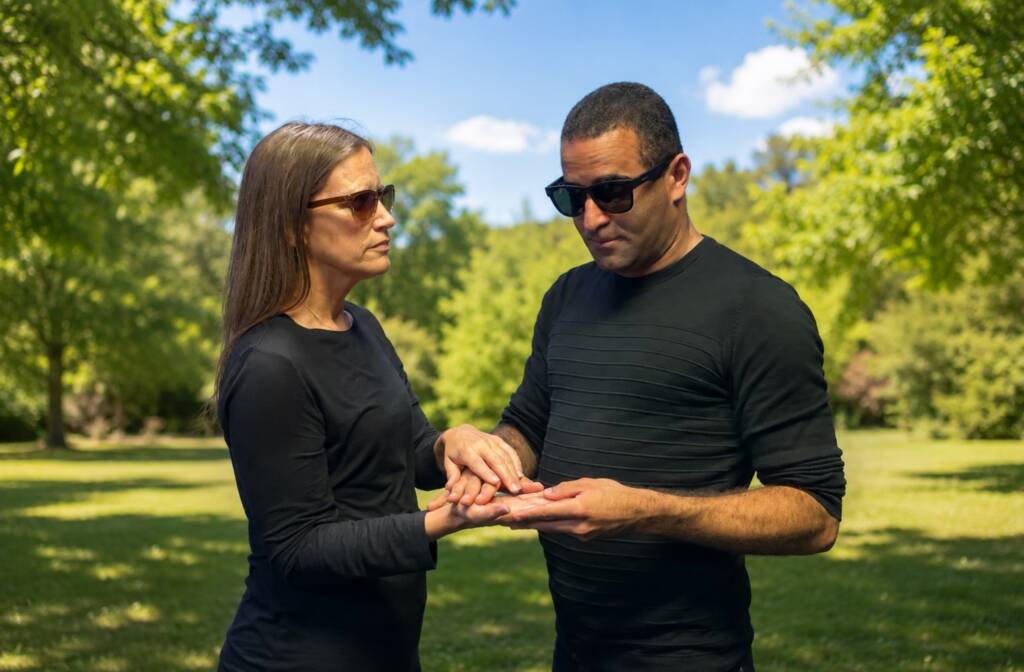
This presentation is led by renowned Protactile trainers Rhonda Voight-Campbell and Roberto Cabrera, who use demonstrations and lived experiences to explore Protactile philosophy and culture and how Protactile communication fosters connection, autonomy and access, within the DeafBlind community.
Whether you are new to Protactile or looking to deepen your understanding, this webinar offers a unique opportunity to learn directly from DeafBlind leaders and gain insight into a communication philosophy that is reshaping connection and access within the DeafBlind community.
This resource includes an archived webinar recording that was originally presented live. It is now available as a stand-alone resource for individuals who were unable to attend the original session or would like to revisit the content.
Additional Resource: Protactile (PT): An Introduction
Ashley: Hello and welcome everyone. My name is Ashley Benton. Sign name is A in the crook of the arm. I’m the Director of Field Services at Helen Keller National Center. Visual description, I have platinum hair, shoulder length. I’m a white female. I have a black shirt with a black blazer and a black backdrop. We’re thrilled to offer you this training today. Helen Keller is so excited to host this, and our journey in providing Protactile language started about a year ago. Our DeafBlind staff at Helen Keller had an awesome group of Protactile trainers come to train us personally. And we have them here with us today, Rhonda Voight Campbell, known as Rho, and Roberto Cabrera also joining us. Those will be our speakers for today. We’re so excited to have both of them. This collaboration has been excellent. Now I’m going to turn it over to Rho to explain the expectations of this training today. So, thank you. Rho?
Rho: It’s, Rho. Hello, hello, hello. Again, I am Ro. I am, I have a PT name sign that looks like this on the shoulder. I’ll show it to you again. And so that’s my Protactile name sign. I want to talk a little bit about myself, give you a little background. I am a female with long brown hair, wearing a dark shirt, sitting with my, Protactile interpreter. I am Caucasian. My primary language is Protractile, that’s what you, see my interpreter doing now. We’re in constant touch. It feels very odd when, my interpreter’s hand is not on my hand. It doesn’t feel like language anymore to me, but now that we’re back in touch, we can then communicate with each other. So, we’re going to… I do try to code switch, when necessary. and so, I will do, some, Protactile language, but also some sign language so that everyone has access. So, we’ll try to go through that process. I want to, make sure that everybody can follow me clearly. Roberto, his PT name sign is, this here. I’ll show it to you again.So how this started for me, like Ashley mentioned, is I have really enjoyed, being a Protactile trainer. And I want to– and Roberto and I want to share our experiences with, everyone. So, when we were asked, if it was possible to provide some training during DeafBlind Awareness Week, it felt like, it’s hard to express, through touch virtually. Our language being a touch-based language of Protractile, it’s such a challenge virtually to have that happen. But we got the idea of maybe, we could, work with some other DeafBlind individuals, and then record that time with another DeafBlind individual and have that be shown here on the webinar.
And after some talks with Ashley, it looks like that’s what we’re going to try to do. So, we did the recording, and we’re going to be showing that today for the webinar. So, we’re excited to see, and would love to hear, from you how, what you think of the videos as well. Do you feel like it works effectively for what it is, or we should try a different approach? Obviously, Protactile being touch, in person is always our better option and our first choice, but I think this will give you an idea of Protactile, what it entails, and what it might look like. When you’re looking at creating language together, that’s what matters. Through video would be very hard, and isn’t quite the same as it could be, with in person. So that is going to be our challenge. But we will have, two or three parts that we’ll go through when it comes to touch and different topics and different things like that. And so, we’ll go and do, we’ll go through those, those steps and what we can do there. so hopefully that’ll be a good experience for everyone and a good, view into Protactile.
Ashley: This is Ashley signing. Rho, thank you so much. We’re so excited again to have you here. I think we’re ready to delve into part one of this training today. We’ll have ASL interpreters on the screen while you’re watching the presentation.
Narrator: Protactile Philosophy Part One. The screen is divided into two panels against a black background. On the left, Roberto and Rhonda are seated facing one another with their knees and thighs touching. Rhonda rests one hand on Roberto’s thigh and the other gently over his hand as they communicate. On the right, a sign language interpreter appears in a separate video window.
Roberto speaking. Hi, everyone. My name is Roberto.
Rhonda speaking. Hi, I’m Rho. We are both here to engage in a dialogue There will be three ways to access our conversation: captions, ASL interpretation, and/or spoken English. Our discussion will focus on four parts: PT philosophy, how the language is being adopted, the structure of PT, and lastly, we will discuss how PT is emerging and evolving as a language.
Roberto speaking.
As you mentioned, PT philosophy is our first topic. We will focus on the how of PT. How individuals use PT. That will be a major focus of our discussion, the process and experience of using PT. We know that hearing people typically use their hearing to communicate with one another. Deaf people primarily use their vision to communicate. PT does not engage either of those senses, instead relies on touch. Through research on PT, we now understand that the language is both an inherent part of who we are and an intuitive means of communication. Communicating through PT requires us to let go of, and in some ways unlearn what we already know. Take a newborn, for example. Our primary means of communicating with an infant is through touch. We hold them, comfort them, and soothe them through our physical contact. Our bond is created through touch. We learn to recognize and respond to their needs, whether they need a diaper change, are hungry or tired, or they’re ready to sleep. Much of that understanding comes from the intuitive connection we develop through touch. As that same child grows, communication can occur across a greater distance. Hearing children communicate through spoken language, while Deaf children communicate through sign language. As language develops, the amount of touch required for communication decreases. As that child grows older, even greater physical distance becomes possible, and very little touch is needed for communication. In many ways, they begin to lose touch with this form of communication. The same child who once relied on touch as a primary means of connecting with others may gradually move away from it. This aspect of communication we can explore in greater depth. As you watch Rho and me engage in this conversation, it requires an inner willingness to look deeply within yourself and reflect upon this journey and process. You are asked to shift, embrace, and internalize touch. That is the PT philosophy at its core, an emphasis on touch.
Rhonda speaking.
Yes, that’s it I also have a personal experience with touch that goes back many years. When I was a child, I communicated through sign language and relied on my vision. Over time, however, that became more difficult. Without touch, communication became a struggle. It was frustrating, and eventually I began to feel lost. As I started socializing with other DeafBlind people who were immersed in PT and using touch to communicate, I began to realize how powerful touch could be. I discovered that I could access information through touch and connect with others in ways that I had not experienced before.
I started learning through touch. For example, when I was cooking, I began to recognize through touch when something was ready to be flipped or when it was fully cooked. Just through touch experiences like these showed me just how much information touch could provide. It changed my life. Touch was incredibly powerful. Roberto, I agree with what you said about PT being both a part of who we are and intuitive. You’re absolutely right. As I continued learning PT, I came to understand that it’s different from communicating with hearing and vision with hearing and sight, information is often accessed very quickly. Touch operates at a different pace. It takes more time. However, we are still able to access information in meaningful and complete ways. It was liberating.
Roberto speaking.
Related to that, Protactile has a number of principles. You just mentioned one of the key principles, information source. If information is unclear through other sources, we must access that information through touch. If we aren’t using touch, but rather relying on vision or hearing instead, the information won’t be clear. PT emphasizes that touch is the primary source of information. Through touch, information becomes clearer.
Rho: That is true. Touch is not simply a means of access. Touch is everything: access, information, and an entire way of life.
Roberto: It’s incredible. For example, you mentioned… well, for example, take the home Information within the home is very important because it’s where we live in our daily lives. We need to think about how touch can be incorporated into the home environment. Consider the physical space itself. Different surfaces can provide information through touch. For example, a rug or floor mat feels different from the surrounding floor. As you move through the space, those differences help you orient yourself. By tracking along the wall, you can identify and follow that surface as well. There’s no need to rely on sight or vision to know where you are in your home. Through touch, you can understand your environment That physical space, your home, represents who you are. It also reflects your everyday life. Home plays a significant role in shaping how we move through the world. Our sense of knowing is grounded in the home. Home reflects our inner sense of self and our values. PT philosophy is embodied in that. It’s not like you can go out into the world and use PT and then come home, set it aside because it’s no longer needed. PT is a part of who we are. It shapes how we understand ourselves.
PT philosophy asks us to consider how we practice these principles and how we bring them into our home. I’m not suggesting touch must be used 100% of the time. Rather, I encourage us to understand how we can embrace touch and continue to use it as a source of information If you choose to embrace touch and rely on it as a source of information, that’s wonderful. Embracing touch allows you to connect with others who also use touch as language. Touch is a part of our values. Touch is how we live. We cannot separate ourselves from it, nor can we learn it temporarily and then set it aside. No, that just will not work
History and Expansion of PT.
Rhonda speaking. Now that we have discussed PT philosophy, let’s move on to our second topic, the history of the language and how it has spread. To begin with, we need to go back several years to two individuals, A.J. Granda and Jelica Nuccio, who are both working at the DeafBlind Services Center, DBSC.
The two of them began to notice and analyze a challenge facing many DeafBlind people Accessing information through sign language, even tactile sign language, was often limited. Communication was not always effective. Misunderstandings occurred frequently, and information was not always clear. AJ and Jelica spent a considerable time discussing these issues. Earlier, you and I talked about the importance of touch as a cornerstone of the PT philosophy. AJ and Jelica recognized just how important touch was and how essential it could be for accessing information and communicating with others. The challenge was figuring out how to help others recognize its value and encourage DeafBlind people more broadly to embrace touch. After much discussion and reflection, they decided to relabel the DBSC a touchstone. This meant that anyone entering the facility was expected to engage in constant touch. For many DeafBlind individuals who are not accustomed to touch in this way, the experience was jarring. However, AJ and Jelica continue to encourage people to use touch, to value touch It was really important that touch could be used to communicate. It was incredible how much information was available through touch. People stopped breaking contact with one another and instead remained connected through touch. Now, remember that the DeafBlind Service Center is located in Seattle, Washington, where there is a large DeafBlind community. AJ and Jelica sought input from the community, piloting these ideas, and through ongoing practice, continued to refine the approach. Take, for example, how hearing people indicate that they have understood what is being said. They often use verbal responses such as, “Yeah,” “Mm-hmm,” or “Uh-huh.” This feedback lets speakers know that their message has been understood by the listener. Deaf people provide more visual responses. ASL is visual with facial expression.
A person might open their mouth or sign, “Oh, I see,” to indicate understanding. But how do DeafBlind individuals indicate understanding through conversation? AJ and Jelica noticed that this type of feedback was often missing. They began to explore ways for DeafBlind people to provide feedback during conversations. Initially, they experimented with adapting the ASL sign yes or no to be produced on the body, but that wasn’t effective. As a result, they developed an entirely new tactile sign for yes and no.
Rhonda places her open palm on Roberto’s shoulder and taps twice for yes and slides her hand back and forth for no. They introduced these new signs to members of the local DeafBlind community to gather feedback about their experiences using them.
The response was overwhelmingly positive. From those efforts, ProTactile began to take shape.
Roberto speaking.
The origin story of PT is really quite amazing They were involved in the inception of PT. They came to understand that PT is a way of sharing information not only from one person to another, but across entire groups and communities. There were still many questions about how PT should be implemented in practice and how space should be organized. Earlier you mentioned misunderstandings and confusion result when signing occurs in space, and people frequently felt disengaged. Maintaining connection can be difficult. Constant touch was better, but there were still questions about how best to use it. Through that process, the PT principles began to emerge
Seven core PT principles were developed. Those principles helped move the work forward. Look, PT was still new. It had just begun, even with all of those principles but it’s still new. Later, research was published demonstrating that PT is in fact a distinct language in its own right.
Rhonda speaking.
Yes. You just mentioned connection, maintaining constant connection. In the past, many DeafBlind people relied heavily on interpreters to communicate with one another. For example, you might have four DeafBlind individuals and four interpreters. Information would be relayed from one person to the next through the interpreters. AJ and Jelica were troubled by this. They asked, “Why were we relying on interpreters? Why weren’t DeafBlind people communicating directly with one another?” They decided to stop using interpreters as intermediaries, allowing for DeafBlind people to have constant touch. This represented a new way of communicating, direct communication. In practice, it looked much like how we look right now, sitting face-to-face with our legs touching, maintaining physical contact, communicating through constant touch.For many DeafBlind individuals, this was unfamiliar and at first could feel jarring. But the question became, can we do this? Can we communicate through constant touch? Is that acceptable? The answer is yes. Slowly but surely, it took hold. That’s the part I treasure, the use of touch to communicate with one another. You and I can communicate directly, sharing information and our way of life, too. It’s a part of our journey. We are trying to reduce the reliance on interpreters. You and I, as DeafBlind people, don’t need interpreters to communicate. We can use PT to talk with one another
Roberto speaking
Communicating with PT creates that connection. I can feel you and your delivery. Communicating directly, I can feel you, your emotions, your tone, your pitch. It’s amazing I can feel all of that through touch. That is a powerful connection. Relying on interpreters to pass the information along, there will inevitably be some loss. Emotions may not come through. That delivery is diminished by the time the information reaches another person, it may be third or fourth hand rather than direct. Inevitably, there will be gaps, and I don’t want that. Direct communication is better. It allows for greater sharing and a clearer understanding.
Years ago, when all of this was just beginning, I remember being unsure of how it all worked. I was unsure where to put my hands or how to use it I remember how awkward it felt at first, but the more I used it, the more comfortable I became. Over time, touch became more defined. In the beginning, we were all trying to figure out how this would all work in practice. As time went on, it became easier, and as you mentioned, we started with the ASL signs yes and no produced on the body, but those evolved into something better. We didn’t need to borrow language from ASL. As we know, the PT philosophy emphasizes touch. Borrowing from other languages just will not work. Plus, for example, we had Print-on-Palm spelling out letters and numbers into the palm of someone’s hand. POP was already familiar to many of us, so we initially drew upon it as we explored ways to develop a PT alphabet. Instead of that arduous task of trying to read ASL finger spelling. However, PoP was not a perfect solution either, another ineffective borrowing. As more DeafBlind people began to use PT, the community naturally developed and refined a PT alphabet It’s still relatively new, and it will continue to evolve. Again, we need to really use touch. Touch is essential, and it’s central to the PT philosophy. What is the information source? Is the source through touch? Then we can build communication from that point. This principle has been documented.
Rhonda speaking.
Here’s another example, suppose a DeafBlind person needs to use the bathroom. Do they wait for someone else to accompany them?
No. They can locate the bathroom independently through touch. By tracking along the wall, gathering information through touch, they can find the entrance on their own. The information is available through touch. AJ and Jelica encourage people to use touch and to access information through touch. They wanted people to understand that it was possible. You can track along the wall to find the entrance to that bathroom. That same principle can be applied to many everyday situations. They encourage people to incorporate touch into their daily lives and recognize it as a valuable source of information rather than waiting for someone to accompany or guide them. Instead, they encourage people to explore independently through touch.
Ashley Benton is on screen again. This is Ashley. Wow, the first part of this training is incredible. I was receiving the information through Protactile language myself, and wow, it was so informative. I do want to remind everyone that we will have pauses in the video every now and then for visual and environmental information that is being given during that conversation.
So that’s why it seems like the video has paused or been put in slow motion. For those who need visual and environmental information, we have paused that video. All right, now it’s time for questions and answers. Stacy, who is my colleague, will be reading those questions verbally, and we’ll ask Roberto, I think Roberto is here, and Ro to now turn on their screens, and we’ll facilitate those questions.
This is Roberto.
Hello. Hello, everyone. I am in the Dominican Republic. I’ve got a… I’m a Dominican Republican man, and I am sitting in the chair with a short-sleeve, black t-shirt on. I just finished a meeting at my office, but I’m happy to be here and participate in the training today.
Stacey: Wonderful. Stacey speaking. I’m going to say the first comment. It’s really helpful to watch ASL interpreting and Pro-Tactile side by side. This is an incredible opportunity to learn more about Pro-Tactile language. Thank you.
My first two first question, is Protactile being used with children?
Rho: This is Rhonda, yes. Or Rho. This is Rho. Yes. Yes, yes, you can use this with children. This like this with the arm onto the shoulder. Children are, we do have, PT for kids. There is research happening now, as well, so we’ve been working with families, with infants from birth, up to five years of age. And so that’s, has been happening for the past two years. It’s such a rich experience to, to be a part of, and we’re noticing these infants, bonding and developing that relationship, with their, with their families. We have the data forthcoming, but it’s so far so good. Yes, you can, work with children with PT.
Stacey: Okay. This is Stacy speaking. I’ve seen from what you’ve shared in the video and have heard that this language has to be taught in person. Where can I go to learn Pro-Tactile?
Ashley: And this is Ashley.
Roberto: This is Roberto, if I could answer that question. Now, ProTactile, would be best learned in person because it’s a language of touch. You really have to experience the physical touch of it to relate to the language and how that works. So, the in-person, of course, is best. There are some communities, where you can get a group together and practice. There’s only a few out there for that. So, we recommend you host something like that and invite a trainer in. But it, it would help you, get the foundational piece, by watching and learning and reading, but in person is really going to be, the best track. You can– we do have a track for interpreters, and also a track for DeafBlind, individuals themselves so that they can, both learn, and then utilize it together, through tactile communication. There’s different, topics that we go into in the interpreter track and the DeafBlind track, but all that starts with the foundations of understanding about PT language and how that works. So, this is a good start, but then from there would probably be better in person.
Stacey: Okay, this is Stacey speaking. we have one question. Do, did you encounter resistance to this level of touch with sighted hearing people? And if so, how did you handle that?
Roberto: This is Roberto. I can start off and maybe Rho can add if, she would like to add anything. This is Roberto. This is very normal. People at first are thrown, sort of like when someone sees sign language for the first time. It feels like their hands are flying. it’s like, are you a bird? It takes a second to really get used to it. It’s foreign. It’s a foreign concept to them. And so, I think it’s just a normal process of learning something new, with that level of touch, they don’t understand right off the bat, and that’s normal. But then once you go through it and you experience it, it starts to make more sense. When you’re working with someone who has a grasp of PT and how it works, it helps a lot as well. Again, if it’s, continued resistance, that’s okay. PT is not for everyone. That’s okay. But whether you are, you know, maybe that person would rather continue with ASL or using auditory, and, and spoken English, that’s fine. The biggest thing is access to language, but PT is a language of its own, English is a language of its own, and ASL is a language of its own. And so, we respect our consumers, and we respect the people that we’re communicating with, and that’s okay. But for this part, if they are open to touch, then this is a good, venue for them to do.
And this is Rho I wanted to add, if I could.
Ashley: Exactly. Yes, Rho, please.
Rho: Yeah, this is Rho. Yes, that’s true. If I encounter someone who is resistant to touch I, talk with them, I communicate with them and say, “Really, the touch is for me. It’s for my access; it’s for my communication.” and sometimes that help. But, but that resistance, happens, and I think sometimes with explanation, the willingness, is there once they know it’s really for me; it’s for my access. And once it starts, it tends to snowball in a positive way from there, and they, and they’re much more comfortable with touch after that.
Ashley: Yes, Rho, would you like to add?
Roberto: Is Roberto. We are a global community. We understand its culture. There’s different religions, different cultures. people have their own traumatic experiences from the past. All of those things, of course, have to be recognized. it is a collaborative language, and it is something that requires both people to participate. But we have to look at the context of the situation that we’re in. I just wanted to mention that also. Those are other factors that may affect someone’s level of touch, acceptance.
Ashley?
Ashley: Yes, this is Ashley. If you don’t mind, I’d love to add, as a student of protactile language, I do recognize, it’s about communication. That’s the bottom line. There’s gender differences with males and females, and the aspect of touch could be intimidating at times, you know? But it’s a language. It’s communication at the end of the day. That’s what we need to think about. We don’t need to think about, “Oh, gosh, this is a male touching me.” No, it’s about language, access to language, and hopefully that will allow people to become more comfortable with it when they frame it in such a way.
Stacey: And this is Stacey speaking. Yes, we have a number of questions about where people can learn more about Protactile. I just want to add in here that we will have some resources and information that we will send to everybody attending this webinar, anybody that’s registered for this webinar. So, you will learn more about that. We also have some questions about the actual, the terms that people are saying is the Protactile Sign. I think we call them Protactile Movements. But a few of our DeafBlind participants would like, a description of what it looks like and how it feels like, and how it feels. But there is one specific request for what is the Protactile Movement for a long time ago, a long time ago? Is there a Protactile Movement for that? Can you describe it?
Ashley: Ashley, who would like to take that one? What’s this Rho? I think the question was how to show a long time ago in PT. Did I understand the question correctly?
Stacey: Yes.
Rho: Okay, I will show you. So, I have my interpreter’s arm, and we want to go back. So, I almost, opposite of slow, the sign for slow, I go with several hands, in a motion going back from the, from the shoulder down to the hand, showing going back into the past.
Stacey: Terrific. This is Stacey speaking. We have a bunch more questions. I want you to know that we will be answering your questions. If not live, we will be sending responses to the group. We’re saving your questions. But the last question I h- have here I know you guys are adaptive. After all, we now have ProTactile. My question is, if a person is missing limbs, what’s been done creatively to circumvent that? I’m sure we can figure it out, but do you have any examples of that?
Ashley: This is Ashley. Roberto.
Roberto: This is Roberto. Language requires reciprocity If there’s no reciprocity, there’s no language, no communication. And Protactile, ASL, English, regardless of the language, it requires reciprocity. It requires that common understanding, the ability to elaborate, the ability to communicate. There would be a preference of area of touch and how they would use that emphasizing Protactile is touch. There are some specific areas of touch, like the arm, and you touch certain areas for certain reasons. However, it doesn’t mean you always have to stay with those areas. there could be an agreement of another area on the body, that works for that person. So, the area where someone is touched can be moved, to, to be more accommodating. it doesn’t always require an arm. You know that reciprocity, once we have the area in place that works for the touch, the reciprocity is there again. But again, it all comes down to that reciprocity.
Ashley: This is Ashley. Roberto spoke to reciprocity, and that is important. We think about back channeling. That’s a concept in protactile language. So, the person who is missing a limb or a part of a limb, may be using that other arm to receive that information. You can use your leg to give that back channeling, so you know that person is still with you, still attentive. Instead of four hands, it might be a hand and a leg to communicate that same acknowledgement that they’re in the conversation, that they are still providing that reciprocity with a different limb. You always find a way. We’re about to watch, so be mindful of that. Let’s get ready. Go ahead and play the video.
Narrator: ABC theory
Roberto: Roberto speaking.
One additional point I’d like to make relates to a recurring theme within the PT philosophy. It’s what we call the ABC theory. A, always; B, be in, C, contact. Again, the emphasis is on connection and contact. Do not disengage. Stay connected through touch. As you mentioned earlier, simply tracking along the wall provides information through touch. We set up space through touch. Information is available all around us.
Rho: Rhonda speaking
I remember when another DeafBlind person first introduced PT to me many years ago. We’re going back quite a few years I was attending DBAC, the DeafBlind Camp Retreat. When I arrived, everyone was using touch. I was stunned at the same time, I immediately felt connected I felt comfortable. I felt relaxed. I didn’t feel that usual pressure of having to work so hard to keep up I simply felt at ease knowing that everyone would support me if I missed something.
I’d be supported and what made it work so well was the direct communication between DeafBlind people. I wasn’t relying on an interpreter as an intermediary. That was such a relief. I have to tell you, I was blown away by touch, the power of touch. It was incredible. And it was then I realized I wanted to incorporate touch into my life from that point forward.
Roberto speaking.
Roberto: I agree, though my experience is different My parents are DeafBlind and so am I. However, we communicate differently. Yes, we all identify as DeafBlind However, I became deeply involved in the DeafBlind community, and it plays a bigger role for me. I worked within the community as a VR counselor. And what I realized we all have in common is a shared experience How do we get information? I thought about touch. How do we connect with people? I found myself asking, “What is the source of information we’re receiving?” The more ref- I reflected on those questions, the clearer the answer became. The source is touch I remember talking with a good friend of mine when we were both living in California at the time, and I asked this person, “How do I start using touch? What are the mechanics of it?” I was trying to figure out how to use it at the time, PT was in its infancy and just starting to gain traction.
There was a video circulating around 2013. I watched it. It showed the new PT including signs for yes and no. I watched that video carefully. It was fascinating. But I wondered, how was I going to incorporate touch into my life? So, I talked with my friend, who was a Deaf-sighted individual. We watched the video together, and we experimented with touch, practiced communicating with one another at the time, I had no access to formal PT training. At that time, I didn’t know the established conventions for hand placement.
Or the reasoning behind them. We struggled through using touch often, having to repeat ourselves. But gradually, things started to make sense. I was still a beginner, so this wasn’t easy.
I decided to pursue more intensive training so I could continue to develop my understanding. There was so much to learn. Where hands should be placed, what setup worked best How to stay connected. The more I used it, I finally really understood. Looking back and comparing where I started to know, the difference is remarkable. I’m impressed with how far I’ve come. I kept an open mind. I remained curious. That propelled me forward. Had I been close-minded and incurious, I would have remained stuck. Instead, being curious and open-minded allowed me to embark on this journey, and that’s how I arrived confident in my use of PT. Technically, you can say that I’ve been using PT for about 10 years. That’s my story and my connection to PT’s language development. And yet, PT is still a very young language. Its beginnings started in 2007, and here we are in 2026. That’s roughly only 19 years.
Consider the United States will soon celebrate its 250th anniversary. PT has only existed for a small fraction of that time, 20 out of its 250-year history. We have a long way to go. The United States has endured because of its Constitution, its principles, and its Bill of Rights. The strength in those founding documents. In a similar way, PT has its seven principles but simply identifying those principles doesn’t mean the work is complete We must internalize those principles. We need its philosophy. We need touch. Together, those elements provide strength, allowing PT to evolve as a language
Rhonda speaking.
Rho: Yes. Touch
I have tremendous gratitude for AJ and Jelica and for their willingness to forge ahead and spread PT They emphasize the importance of touch and constant contact like we’re using today. It’s inspiring, and it has improved the quality of life for so many DeafBlind people. It’s so important to understand the philosophy and how PT has spread. The history is critical.
Roberto speaking
Roberto: We have discussed PT philosophy. We’ve talked about its history. Our third topic is PT as a language is a formidable topic. You and I have already made it clear that touch is critical. We need that connection through touch. For example, hearing people establish connection through sound. Deaf people establish that same connection through vision. How do DeafBlind people make that same connection? Through touch. Language requires a give and take between people, something that we call reciprocity. Without reciprocity, language cannot function. We must engage in reciprocity. We’ll talk about that a little more and about how reciprocity works later.
Rhonda speaking.
Rho: Remember when we talked about the DeafBlind community experimenting with touch as a means of communication, figuring it out in real time what worked? Through that process, elements of a new language began to emerge. We discussed examples like new signs like for yes and no, which gradually became more widely used. No one set out to intentionally create a language. Language is a natural phenomenon.
Around that time, a researcher, Tara Edwards, began exploring whether a new language was emerging within the DeafBlind community. Had they, in fact, made their own language? Through her research, the evidence suggested that the answer was yes. The question of whether PT was a language in its own right appears to have been answered. Yes. So, the language developed as the community used it. AJ and Jelica went ahead and developed the seven core principles. These principles were developed only as a guideline; they do not define the language. It was important to emphasize PT language must include touch. PT must involve all four hands. Together they create the contact and connection necessary for protactile language to occur. And that’s how the language gets established. That’s the Pro Tactile history.
Roberto speaking
Roberto: Exactly. For example, PT involves all four hands and includes specific conventions for hand placement. Protactile also defines how we engage one another’s hands while communicating through touch. In many cases, we use another person’s hand as a referent. There are established ways that our hands make contact, such as hand under hand. There’s been considerable discussion about the grammar of PT and its rules that govern how language works, including how PT uses space.
Again, I emphasize the importance of reciprocity. For example, suppose I am telling a story, and I spell the word ball. You have an image of that ball. I, of course, have my own image of the ball. The audience observing us may have yet another image. These could be three very different interpretations. So how do we arrive at a shared understanding? I have to provide more detail.
I can describe what the ball looks like, what it feels like. Is it large or small? Hard or soft? Light or heavy. I can describe its shape. The point with PT is I can take your hand and use it as a referent. I can show whether the surface is bumpy or smooth. I can manipulate your hand and physically demonstrate its qualities. You and I, through touch, have a shared referent which I can describe. You and I now have a shared understanding of the object. If either of us are unsure about an aspect of the referent, we can always make that connection for example, let me pick up this object Roberto picks up a green tennis ball and places it in Rhonda’s hand. Now you have a ball in your hand. Both of us have our hands on the ball. You and I are both connected to this ball. Now, if I remove the ball and engage your hand as a referent for it, we can continue discussing the ball and its qualities. You and I are connected to the concept of the ball. We have a shared understanding. I’ll put the ball away. Here’s another example Roberto picks up a green small glass ornament and places it in Rhonda’s hand I’m placing this object in your hand to explore through touch.
Narrator: Rhonda explores the ornament with her fingers.
Roberto speaking
Roberto: The object is a Guatemalan bird. A Quetzal. Now that we have established a shared point of reference, you and I can develop different things. For example, what do we do with this object? We can build a story from that shared tactile experience. For example, I’ll demonstrate that in PT using one of your hands to form the referent, the bird. I can position your hand to represent the beak, move further along your arm to show its plumage. I can continue along the length of your arm to show the long tail feather. I can move back up your arm and hand to describe the bird and show how it hangs from the keychain. You understand. You can picture the story. You understand the bird has a very long f- tail feather, that it is beautiful, and has plumage. I can develop a story where you and I share the same image of the bird and connect it to everyday life.
Rhonda speaking.
Rho: Yes. Through PT, you and I can have a shared experience. As I take your hand to create a referent, we can explore it together through touch. You and I can have a shared experience discovering and learning information together. You and I are actively involved in my story. That is why PT requires two people communicating in reciprocity. You and I develop the story together.
For example, I take your hand as a referent for a dog. I can touch your hand to represent its fur or its tail wagging. I can use your arm to show the harness being placed on the dog.
Narrator: Rhonda shapes Roberto’s hand into the head of a dog by closing his fist, bringing his fingers and thumb together to form the snout, and extending his index finger and pinky to represent the ears. She then slides her hand down his forearm as though placing a harness on the dog and mimes fastening the buckle on each side. and a leash being attached.
Rho: I can communicate how I would say, “Ready? Let’s go for a walk,” to the dog. I just told you that story. You can tell me in PT about it.
Roberto speaking.
Roberto: Well, there’s dog fur. The dog is cute and excited because it’s wagging its tail. It has a jacket on, or perhaps the harness of a service dog you connected the leash to the collar. And you asked the dog if they were ready for a walk, and then you and the dog headed out together.
Rhonda speaking.
Rho: Exactly. Through PT and touch, you felt the story and became a part of it. You were following along in real time. It wasn’t me telling a story and then having it relayed to you. Instead, you and I were engaged in the story together as it unfolded. That’s PT. That’s Protactile language.
That is a part of language development too. Through PT, we can work toward a shared understanding.
Roberto speaking.
Roberto: Take the example of the ball. My understanding of the ball may be different than yours. However, once it’s described through PT, I gain a richer understanding. I understand more about what it looks like, about its properties, and what it is. That’s the same for the bird example or your example about the excited dog wagging its tail ready for a walk. I could feel that energy. We both could. What people may notice about us is we always have constant contact between our hands. Our hands shift naturally. Sometimes your hand is on top, sometimes mine. This means both of us are actively engaged. So, for those out there, whether DeafBlind or sighted, engage in constant touch and tactile communication. That’s how language works. The language requires at least two people who remain connected through touch as they communicate. That is how the language will continue to develop.
Rhonda speaking.
Rho: For example, if I were to go food shopping, moving through the store, putting groceries in my shopping cart. As I use touch to access information, and I’ll use your hand as a referent for the apple I pick up an apple and explore it through touch. I want to show you how I determine if it’s good or a bad apple through touch.
Narrator: Rhonda has cupped Roberto’s hand into a fist to represent the apple. She lifted his thumb to represent the stem. Rhonda feels around his fist as if she is feeling the apple.
Rho: I can let you know how to do that by feeling the apple. I will feel if it’s too soft. If it is, I’ll put it back. I’ll feel if it’s smooth and hard and whether there are dents or bruises. If it feels good, I’ll keep it. You and I, through touch, learn how to distinguish between apples which are good and those that should be avoided. That’s how we learn through language, information shared through touch. It’s important for the DeafBlind community to share what we know. When someone gains new information, it’s critical that information gets shared within the community. That is what creates community. That’s how DeafBlind people continue to develop and grow together.
Roberto speaking.
Roberto: Indeed, language requires reciprocity. You also just mentioned a shared experience; we refer to that as co-presence. Co-presence is extremely important. For example, two hearing people may be listening to music together One person hears a song that they love and begins talking about it with the other person. Immediately, the other person understands. You and I not, might not understand that experience, but they understand each other. Similarly, two sighted people may be walking together when one notices a beautiful tree.
They begin analyzing its color. One person thinks it looks blue, while the other person thinks it looks purple. They go back and forth comparing their perceptions. Now, you and I use touch to create our shared experience. We may explore something together through touch. We discuss it, we both feel it, we both interact with it. That is co-presence. You and I are having a shared experience right now. We are both understanding and engaging with the same thing at the same moment. PT language requires reciprocity, and it requires co-presence, that shared experience.
Rhonda speaking.
Rho: Yes. Here are three things that PT has. PT language has a structure, it has a grammar, and it has what we call contact space. Let me just say how critical this is because, for example, ASL tends to have most of the signing done in airspace. That is not touch friendly. It means we aren’t feeling the signs. ASL signs are simply produced in the space in front of a signer. You can’t really feel that. Instead, in PT, contact is made on the interlocutor’s body. That is how we access PT, by making contact with the other person so that the person can feel the tactile movement signs when you tell a story. We use defined contact space, the legs, along the arm, across the chest, and that’s what PT involves
DeafBlind Community.
Roberto speaking
Roberto: We have now discussed PT philosophy, its history, and the language itself. All of these topics are crucial to understanding Protactile language. Last but not least, we need to discuss the community of users. The first three topics would not exist without the community. The community is where PT began. Without community, PT does not work. The DeafBlind community is key for many years, PT was an ongoing topic of conversation within the community. Whenever we gathered, we were using PT. It went largely unnoticed, however. We used it in meeting rooms and other community spaces. Much of this activity, however, went largely unnoticed by the broader world. It remained primarily within the community. It wasn’t until DeafBlind people started using PT in public spaces that it became more widely visible. People started to take notice. More individuals became involved in studying and researching this emerging language. As this work was documented and published, awareness of PT continued to grow.
Rhonda speaking
Rho: I agree. The DeafBlind community is essential. That is how we come together to create a space for PT. For example, the DeafBlind camp, PT trainings, the PT house are all examples of this. The workplace can be another. Any time we come together and use PT, we are exchanging information, building connections through touch.
Oh, and the DeafBlind Cruise is another example. That’s a good one. There is so much socializing and use of PT in that environment. These provide opportunities for people to experience PT. We need all of you to support and encourage our community. This is how language spreads. This is how language develops, how PT continues to grow.
It’s important for people to understand that Protactile language belongs to the Deaf community. In the same way that the Deaf community has their language, PT is our language, a tactile language based in touch.
We want people to encourage mutual respect for our value of touch. It’s important all of you recognize this and encourage this. Do not be dismissive and push us away. Use touch. It is important to recognize its importance to the community as a value at the same time, recognizing that the language of the DeafBlind community is still emerging all languages evolve and change. That’s a normal process.
Roberto speaking.
Roberto: Even if you try to create a PT-friendly space and provide information or instructions to a large group. It simply will not work in the way that you’ve always done it. I want to be clear about that. It just does not work. For example, if I were standing on a stage addressing a large audience with significant physical distance between us, it simply will not work to use PT. Instead, DeafBlind people need to be in smaller groups with less physical distance, sharing the same space, where information can then move from group to group. That is a very different model from a single person presenting to a large audience. There is more reciprocity, more touch, more connection. Sometimes there may be more people engaged. For example, we know PT can’t happen with only one person. That does not work. Oftentimes, there are two people communicating in PT, though you could have three or four people engaged in the interaction.
There is information sharing, there is reciprocity. Then once that is shared, that message moves to the other smaller groups at a slow pace All of you must ask DeafBlind people how this works. They will tell you there has to be touch, connection, and reciprocity.
If all of those pieces aren’t there, it simply will not work We need to think about how space is used and encourage new ideas. Maybe a DeafBlind person has a very different way of engaging. Some DeafBlind people prefer to have information provided in a written form with everything typed out in a document that might be emailed out to everyone. They choose to read the information independently for access If you’re asking when a meeting should start, 9:00, 9:30, or 10:00, some DeafBlind individuals would like to get that information through PT. There are different ways of getting information. You have to find the way that works for them. At the same time
We need to encourage the growth of the language and value identity as something to be treasured.
Rhonda speaking
Rho: That’s part of the language. Our community has its own way. We can only move forward with continued support getting access to information. It’s different from other communities. We can’t model ourselves after other communities We have to stay on our own path. All of that is a part of our community. It’s critical. And touch is the cornerstone in order to make that connection with us, with the DeafBlind community, you must have touch.
Roberto speaking.
Roberto: Also, how to start? It’s through touch. Touch someone’s shoulder and engage their hand. That’s how you begin. Language will happen.
Rhonda speaking.
Rho: Right. It’s important that all of you begin thinking about touch. Touch really does connect people. It can. Through touch, we connect with one another.
Ashley: This is Ashley. Now our final question and answer session. Roberto and Rho have joined us on screen. This is Ashley. Thank you so much. Stacey, do you want to facilitate the questions and answers that we have?
Stacey: When back channeling, is there a way to indicate that you’re receiving the information but are in shock, or maybe you’re completely disagreeing with what’s being said? How would you do that? Can you describe that?
Roberto: This is Roberto. Rho?
Rho: This is Rho here. What’s important is your reaction showing fully through the feel of your body a shock. So, it’s just sort of whatever naturally happens. you know, your body tenses up when you’re shocked about something. You would do the same through Protactile.
Stacey: Okay, this is Stacy speaking. Oh, Roberto, go ahead
Roberto: This is Roberto. Yes, I, I would like to add. When you’re thinking, a tap on the hand means yes, but there’s actually different taps. There’s affirming, which means I understand, or I’m nodding, or I’m following what you’re saying. Those are just affirmative or affirming responses. Whereas then you have negation. Your responses. No, I don’t understand, examples like that. Those are negations. So, then you have instead of tapping, it’s moving back and forth like a head shaking in the negative. So, you start there, affirming and negation, and then there’s, stuff that comes, from, in those, categories. And then you have a range of emotions. Sad, happy, mad, all those are core, emotions, and all of those can be, portrayed through UT.
Again, as I mentioned before, reciprocity. You can develop an additional, protactile language between you and the person you’re c- having a conversation with, while you’re having a conversation. That’s like, what we mentioned earlier, back channeling
You have your listener who is receiving the information, or as we use receiver, who’s receiving the information. They’re reacting to the information. You could be, you could have one receiver, two receivers, even three receivers
All of those receivers would be reacting. So that would be where the shock would come from, is from the receiver.
Stacey: Karen asks, “I learned through you and outside of here, that learning Protactile is to really be different and leave out ASL, not include ASL. But as I’m watching, I see a lot of ASL and finger spelling being used. Is that because the language is still being developed?”
Rho: This is Rho here. Like any other language, we tend to borrow, words, phrases, what have you, into a language. and PT is the same. We borrow a lot of ASL into Protactile. However, as time has gone on, the influence of ASL has become less and less evident. PT has emerged as its own separate language.
But you may see something and recognize it as, an ASL feature. and it may just be that PT has not developed in that area quite yet, and so we loan, communication from ASL.
Roberto: This is Roberto, who wanted to add as well. Yeah. it takes time. The seed has been planted. The foundation is there based on the planting of the seed. But when you plant a seed, it takes water, takes sun, and then you get your first sprout. And as the it sprouts, then it grows and becomes a beautiful flower or plant. and, with COVID, and all of us are still sort of recovering from COVID, there was this two-year gap of disconnection through COVID.
However, we’ve been working on reconnecting since, and our community is getting together more often. but we’re starting with that seed. PT had some growth prior to COVID, but then that disconnect set us back, and so now it’s developing even quicker than it was before. And actually, in the last two years, we’ve learned time, how that works. Seasons, days, all of these things have developed just in the last two years, which is a huge development linguistically and has been really nice. But the language is transforming, and it’s because of the community being involved, people feeling it, understanding it, grasping it, and utilizing it. So just like Rose said, it takes time, but as the time has gone by, less and less ASL is present.
Ashley: This is Ashley. I also did want to add, during the video, you may have noticed Roberto showing some things in Protactile. He wasn’t using, American Sign Language using the fingerspelling. He was using braille letters represented on the other person to add clarity. If they were missing the fingerspelling, the fingerspelling wasn’t clear, they added those letters in braille. Okay. Again, thank you, Roberto. Thank you, Rho, for your fantastic presentation of PT Philosophy hosted by Helen Keller National Center. Hopefully, we’ll be offering more that continue this beautiful collaboration. We definitely want to support our DeafBlind community in this emerging language If we all work together, we can spread the language even further.