Haptics Video Series
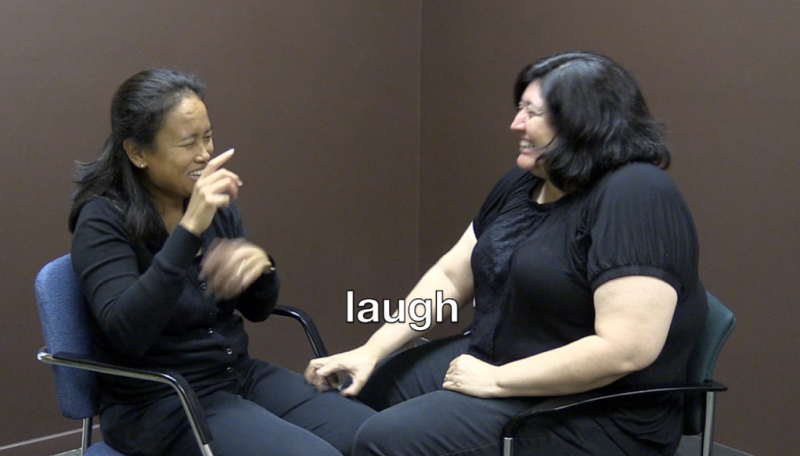
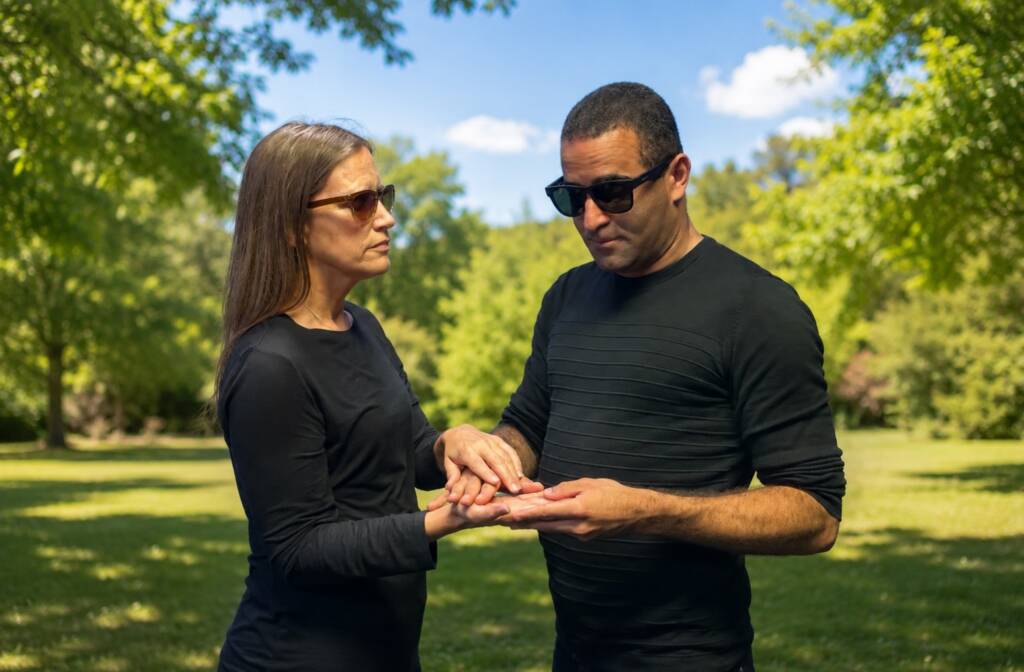
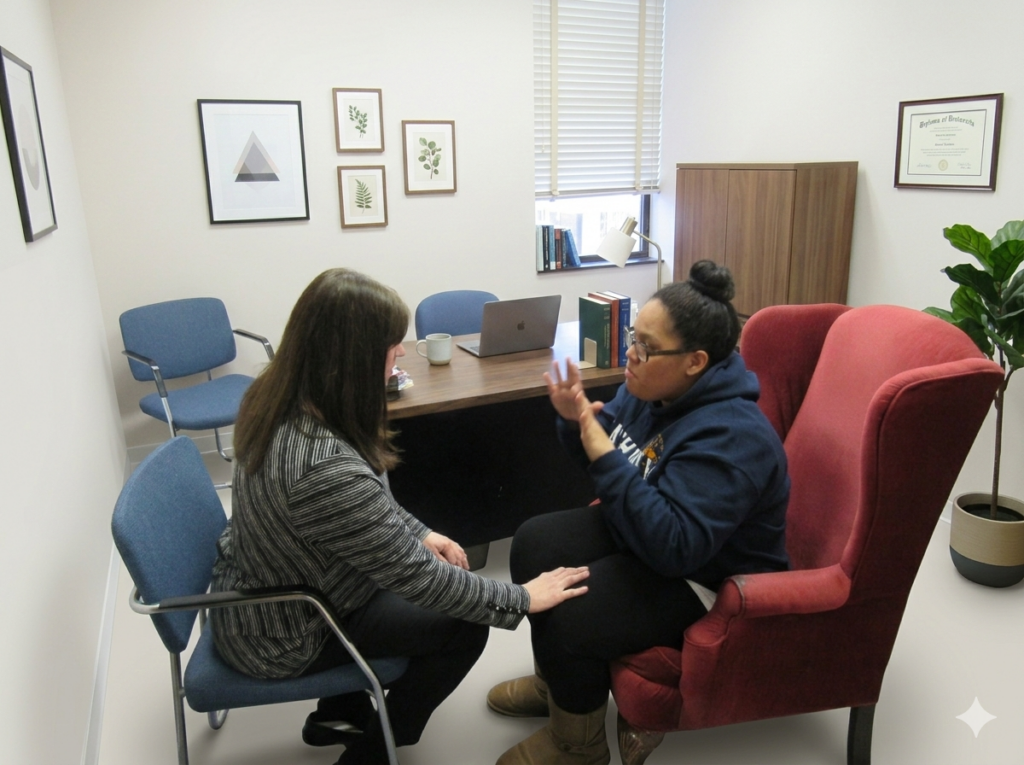
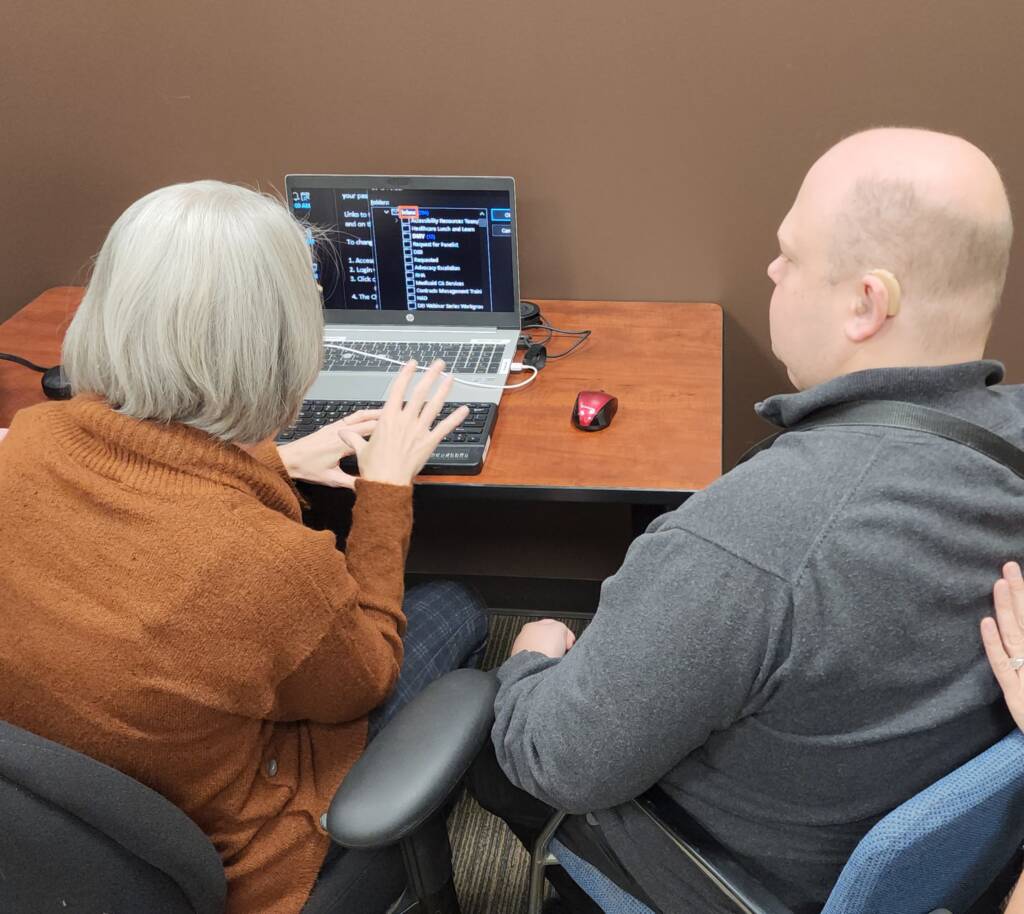
Haptics is a standardized method for providing access to visual and environmental information for DeafBlind individuals via touch signals on the body. This can be used to discretely and easily provide access to information such as facial expressions or reactions, and visual information such as who is in the room, where things are located and so much more. This access allows DeafBlind individuals to stay connected and informed in real-time interactions.
This resource provides an overview of Haptics, including its history and origin, who uses it, and how it is applied across various settings. You’ll see demonstrations of Haptics in action, learn about how it differs from Protactile and hear directly from DeafBlind individuals who use these techniques in their daily lives. Whether you’re a professional, family member, or someone new to the DeafBlind community, this resource offers valuable insights and guidance on where to learn more.
Haptics: A standardized system for providing and or receiving visual and environmental information as well as social feedback via touch signals on the body.
Haptics Overview
Haptics. Maricar Marquez. Helen Keller National Center.
Haptics. A standardized system for providing and or receiving visual and environmental information, as well as social feedback via touch signals on the body.
Video image description: A closeup of a woman signing into the camera.
Hello, I’m Maricar Marquez. I am going to be talking to you today about haptics. This is the sign for haptics. Image description: Both hands are positioned palm facing down at chest level with elbows bent. The right hand is first placed on the left wrist, and then the left hand is placed on the right wrist. This happens in a fluid motion.
Haptics is a method that affords people access to environmental, visual, and social information. This information is critical for individuals who are DeafBlind as it affords them the ability to make choices and or decisions based on the environment they find themselves in.
It allows a more complete vision or perception of the setting and the content within. Please keep in mind, I’m not speaking of information that is communicated through speech or American Sign Language, but rather a person’s facial expression that might look facetious, something that I might overlook because I simply cannot see it.
Haptics allows me to have a full understanding of what’s happening around me. It completes the picture for me.
Examples of the type of information that one can receive using haptics include visual and environmental information, such as facial expressions, directional information. Size, amount and intensity. Actions, layout of a room or an area, food or drink items, identification of people, description of people and objects.
Haptics can also provide social feedback such as personal reactions, directives, prompting, confirming or negating, identifying oneself or sharing personal emotions, and so much more. Haptics is a standardized system of signals, but note it is not a language. These signals have specific parameters and are placed in a specific location and have specific meanings.
People who are DeafBlind use a variety of methods to access visual and environmental information. Haptics is one of these methods.
DeafBlind people receive information in a variety of ways, including speech, sign, language, text, and or touch.
There are benefits to receiving visual and environmental information via touch, also known as haptics.
The two main benefits of haptics over other methods is that it affords the receiver the ability to receive information in real time, and it allows it to be conveyed discreetly. Typically while communicating, there’s a lot of turn taking, or waiting, before you can respond. Using haptics, one is able to provide feedback without disrupting the flow of communication while actively engaging in the conversation.
For example, suppose I’m facilitating a large group meeting where I’m at the head of the room. My boss walks in. My provider cannot interrupt my presentation while I’m speaking in front of a large audience to give me this critical piece of information. It’s obtrusive and potentially disruptive through haptics.
My provider can discreetly, in real time, give me this information and I can continue my meeting ensuring that I’m aware that this key person has entered the room. Again, it’s done discreetly.
Here is an image of Maricar at a recent haptics training. To her left is a tactile interpreter who’s interpreting a question that’s being asked by a member in the audience, and to her right is a haptics provider who is providing haptic signals on her back.
I just shared an example of how haptics can be used to receive visual and environmental information for the meeting I was facilitating.
Now I’d like to talk about using haptics to receive personal interaction or social feedback in a one-on-one or small group setting. Haptics affords a DeafBlind person the opportunity to glean information such as laughter, someone smiling, perhaps looking quizzically. That happens in a conversation where I might miss these cues if I’m unable to access them visually.
The addition of this type of feedback allows me to engage instantly, appropriately, and actively be part of the conversation, and with those around me how haptics has impacted my life.
Haptics is such a tremendous resource as a DeafBlind person. I highly value the ability to access the information around me, but as my vision deteriorated, as my hearing deteriorated, I simply didn’t have the same access to information, and I lost my connection to things around me. Haptics has given that back to me for more information.
For more information on haptics, we have a wealth of information available to you. The Helen Keller National Center is available for questions. Please contact us.
We have online courses, we have training available. We have a haptic book. Feel free to reach out to HKNC at any time. For more information, contact pld@hknc.org.
How Did HKNC Learn About Haptics?
How did the Helen Keller National Center learn about haptics? Video description: closeup of a woman signing into the camera.
You might be wondering how the Helen Keller National Center became involved with haptics. A group of people representing an organization called Hapti-Co visited HKNC. During this visit, they provided us with information on haptics.
Hapti-Co is an organization that was developed to serve the DeafBlind community by providing continued education, training, and resources on the use of haptic communication. Hapti-Co staff travel around the world to share this system with all who may benefit.
Here’s an image from one of the trainings provided by Hapti-Co at the Helen Keller National Center.
The presenters are in the front of the room with a large PowerPoint behind them. There are approximately 30 people seated around tables throughout the room. There are a combination of interpreters and participants. Many of the participants are receiving interpretation via tactile A SL. A second interpreter is providing the haptic signals on the person’s back, copying the signals being presented in the front of the room.
A book was published in Norway that outlined the signals used in haptics HKNC collaborated with the authors of this book, Hapti-Co, to create an American version that was sensitive to the linguistic and cultural needs of DeafBlind Americans. We wanted to ensure that it met the needs of the American DeafBlind community and their perspectives.
Here’s an image of the book: Haptic Communication, the American Edition on the cover are two women standing outside in front of a pond with trees all around them. One woman is providing haptic signals to the other. For more information about this publication, please contact us at pld@hknc.org.
Who Uses Haptics?
Who Uses Haptics? Video image description: A closeup of a woman signing into the camera.
At this point, you might be wondering who uses haptics. This is not only for interpreters, it applies to anyone. Interpreters, SSPs, family members, friends, service providers, DeafBlind people, truly anyone.
Examples of haptics in use in various settings. Here’s an image of Maricar and a young girl shopping at an outdoor market.
Maricar has a necklace in each hand. The young girl is using haptics to let Maricar know the color of each necklace.
And here’s an image of a DeafBlind woman filling up a pot at the sink. Her young son is using haptics to let her know when the pot is full. And finally here we have a vocational trainer using haptics to provide feedback to a young DeafBlind man who is working in the laundry room of a local hospital.
A DeafBlind person can be either a provider or receiver of haptic communication. As can interpreters, SSPs, family members, friends, service providers, we can all become provider or receiver in an instant.
For example, I as a DeafBlind person can also either be a receiver or a provider of haptic communication. My husband is hearing and sighted and you would think that he’d be the provider of information, but he can sometimes be a receiver as well. We’re often out and about biking through New York City. Some of our trips can be as far as 40 miles. We ride a tandem bike where I sit in the rear.
Here’s an image of Maricar and her husband riding their tandem bike through the city.
And if I need to tell him something like, “Hey, I need to stop and use a restroom.”, I use haptics on his back by drawing a “T”, which lets him know that I need to stop in this situation.
I can’t use speech or sign language to communicate, but through haptics, I can become the provider of information and get him to understand what my needs are, that we need to stop.
Now, please keep in mind that not all providers and receivers are going to know every signal used in haptics, but rather use the signals that are appropriate for you and the setting for which you need them.
There is some receivers who want to know all of the information they possibly can in a given environment, whereas others may want only to focus on a few key elements. So it really does depend on individual preference and situation.
Prioritizing Information
How do you determine what information to prioritize when providing visual and environmental information? Video image description: a closeup of a woman signing into the camera.
You might be wondering how a provider can prioritize information they give to a receiver. First and foremost, you wanna use the information that will allow the DeafBlind person a more complete picture of their surroundings.
Factors that influence the type and amount of information to be provided include the situation or setting the receiver is in the role of the receiver, the current status of their vision and hearing the age of onset and their personal preferences, situation or setting. Other things that may influence how you prioritize information, include the setting type.
Is it more formal or casual? Is it a school setting, a meeting, or perhaps a job interview? Or is it more social like a recreation event or social gathering
Role of the Receiver.
What is the DeafBlind person’s role in this setting? Is the DeafBlind person facilitating a meeting or discussion, or are they a participant? If the DeafBlind person is leading the meeting, or perhaps they’re in a teaching role? The information that is provided to them might be more plentiful as they need the information to stay on task and manage the situation, whereas a DeafBlind person as a participant may require less information to be an active participant in the setting.
One example comes to mind for me is that I’m the supervisor of a department and one of my functions is to hold weekly staff meetings. As a facilitator, all dialogue is being provided to me through a tactile American sign language interpreter who is seated to my left. I don’t have enough usable vision to see if my staff are attending to me or are they looking at me oddly, are they looking down, texting, rolling their eyes, or chatting?
All of this is unbeknownst to me. I need to know reactions so I can manage them effectively. So if there are two staff people perhaps chatting with one another, I can interrupt and ask what they’re talking about. If someone rolls their eyes, I can immediately ask about their reaction as to what just happened so that we can dialogue the content.
Now as a participant, I would also be oblivious to the chatter going on around me as I’m attending to the speaker at hand. Since I’m not facilitating the meeting, the chatter is not as pertinent to me. Typically, a participant requires less information than one who is facilitating the meeting.
Age of Onset and Current Status of Vision and Hearing Loss.
Let’s talk a bit about when one’s vision loss and hearing loss occurs. I grew up Deaf and later started to lose my vision. I had excellent visual memory and was able to see colors, a great fashion sense, and was able to see what people look like.
But as my vision deteriorated, this type of information vanished. However, I highly valued and wanted this type of information. I wanted to know the color of things, what someone looked like, and what clothes people were wearing and what was in fashion.
Conversely, someone who is born blind and does not have a visual memory, has never seen color or what people look like or what clothes they’re wearing. This type of information is not valuable to them, and inherently the types of information we would want are different. So color type, style, are likely meaningless for them.
Personal Preferences.
Personal preferences will vary based on setting, based on the role of the DeafBlind person and quite honestly their individual priorities. Some people may want an enormous amount of information, whereas another person may want significantly less information. For some, too much information is simply overwhelming.
Protactile vs Haptics
What is the Difference Between Protactile and Haptics.
Video image description: A closeup of a woman signing into the camera.
You might be wondering what is the difference between Protactile communication and haptic communication? Let’s talk about it. Protactile communication is diverse and expansive, whereas haptic communication is simply a standardized system of signals. Haptics is not a language.
Protactile communication is a philosophy, a language, a culture, and a movement. It is intended to promote equality. An access for individuals who were DeafBlind and was created by DeafBlind people.
Protactile can be used in a one-on-one or group setting, but it is not standardized. The use of touch is more intrinsic and organic, where communication partners decide what is best for them through touch.
We at the Helen Keller National Center support and promote all individuals rights to choose whatever method or philosophy that works for them. For more information about the Protactile movement, please visit www.protactile.org.
Haptics, a standardized and documented system for providing visual and environmental information, as well as social feedback via touch signals on the body. Developed in the early 1990s by DeafBlind individuals in Norway and neighboring Scandinavian countries.
Protactile, PT, a philosophy, a language, and a movement that promotes equality and access for individuals who are DeafBlind. This includes purposefully non-standardized methods for providing visual and environmental information. PT was developed in 2007 by leaders in the DeafBlind community in Seattle, Washington.
For more information, go to www.protactile.org.
Ashley Benson: Using Protactile and Haptics with Football
Hi, my name is Ashley Benton. My name sign is an A Hand Shape in the crook of my elbow. I wanted to talk to you about my philosophy of touch communication. You may be familiar with the term haptics or pro tactile, signed as pt, and you might be wondering, which I use well. I actually use both as well as other methods that allow me to have successful communication and be included in everything.
Now, what’s the difference between PT and haptics? PT is more of a philosophy, a culture, and a language. It’s inclusive of all three. PT was born and spread like wildfire throughout the DeafBlind community. It is a natural, intuitive language that enables two [people to be active participants in a conversation by providing attention, being responsive, providing feedback that we are mutually engaged.
From a cultural perspective, it emphasizes the value of touch, the use of the body simply to be connected. Haptics, on the other hand, is a system, a method that has a fixed set of signals. That means specific things. Furthermore, these signals are presented in a particular order. There are set reference signals that can be categorized.Because this is documented. It’s a system that’s easy to teach. It has rules. There are benefits to both, as I mentioned. Haptics is easy to teach. It has a printed book. There are prerecorded presentations that you can watch at the ready, and it’s standardized. So both parties know a specific signal means a specific thing.
There is a mutual understanding. It’s uniform. Whereas PT is intuitive and creative, really no two signals mean the same thing. Signals are created to match your style. If you think about ASL as a language, no two people sign the exact same way. There are some who sign more calmly where there are others who are much more expressive with their facial and body language. Again, I use the word style because PT users can touch more emphatically or dramatically or maybe lighter or softer. There is no right or wrong. It’s whatever feels comfortable and instinctual to the person you’re speaking with. PT is a creative endeavor. I do use both. For example, I may be watching a football game or a basketball game, and I might actually at the game on the spot create signals to mean specific things for this game on the fly,
this short video shows Ashley at her son’s football game.
We see her from behind facing the field. Standing behind her is a provider who uses pro tactile incorporating customized signals that Ashley developed for this context, the provider places both hands on. Ashley’s back to represent the two teams lined up and facing each other. Using her index finger, she traces the ball’s.
Movement then uses her hand to show one team advancing toward the ball carrier and making a tackle. Each hand continues to represent a team’s position and movement throughout the play. The team on the right kicks the ball indicated by a flicking motion, followed by the finger tracking the ball’s direction.
The team on the left makes the tackle this time tapping motions from both hands. Signal a touchdown, then fingers moving up and down across Ashley’s back, represent the crowd clapping and cheering. Throughout the interaction, Ashley nods indicating she’s following and engaged with the game.
Now, these signals could become standard for me and can be documented so they can be used again.
I might take a picture of them or write them down on a piece of paper and then use them with different people. For example, I’ve created a signal for touchdown in football or a three-point shot in basketball. I’ve set up. Specific signals on my back that I use over and over again at games. So they do become standard for me.
These signals are things that I’ve come up with that, you know, feel right and make sense to me, and I’ll come up with them in that moment. So again, they do become standardized, but only for me.
So PT works for me, allowing me to become engrossed in the activities that I would’ve previously been a passive participant. It works for me and I encourage you to come up with things that work for you. Haptics work, if you use them consistently, they can be used in multiple situations. It can be easy to build upon your foundation.
The beauty of PT is that it’s natural, it’s intuitive, and you don’t feel compelled to get the signal right. It is whatever feels normal for you. Both haptics and PT are simply part of who I am.
Haptics – Where to Learn More
How can I learn more about haptics? Helen Keller National Center.
Video image description: A closeup of a woman signing into the camera.
To learn more about haptics, there are a number of free resources on the Helen Keller National Center website. Trainings are available in your local communities provided by HKNC staff.
There are also opportunities to attend training at the Helen Keller National Center.
A great reference is the American Edition of Haptic Communication, adapted from the original Norwegian version.
If you would like more information, please contact the Helen Keller National Center’s IRPD department. Contact HKNC at pld@hknc.org or go to www.helenkeller.org/hknc.